Showing posts with label New/Recent Scholarship. Show all posts

Tuesday, January 6, 2026

Out Now - The Music of the How to Train Your Dragon Trilogy

Recent from McFarland

The Music of the How to Train Your Dragon Trilogy: A Guide to the Scores of John Powell

Erik Heine

Full details and ordering information at https://mcfarlandbooks.com/product/the-music-of-the-how-to-train-your-dragon-trilogy/. 


Format: softcover (7 x 10)

Pages: 208

Bibliographic Info: 101 photos, appendix, notes, bibliography, index

Copyright Date: 2024

pISBN: 978-1-4766-9367-5

eISBN: 978-1-4766-5232-0

Imprint: McFarland


About the Book

One of the many reasons why children and adults love the How to Train Your Dragon films is the music. John Powell composed the music for all three films, maintaining thematic consistency while writing new themes for each film. This book serves as a score guide for the How to Train Your Dragon trilogy. Every note has been examined to thoroughly discuss the music for Hiccup, Toothless and the other dragons, Vikings, and the enemies and friends that they encounter. It features interviews with the composer and nearly 100 musical excerpts.


Table of Contents

Acknowledgments viii


Foreword by Tim Greiving 1


Preface 3


Introduction 5


1. Musical Influences on the HTTYD Music 15


2. Pitch Collections 24


3. The Themes of the HTTYD Trilogy 30


4. How to Train Your Dragon Cue Analysis 58


5. How to Train Your Dragon 2 Cue Analysis 96


6. How to Train Your Dragon: The Hidden World Cue Analysis 134


7. Themes Across the Trilogy 174


Conclusion 185


Appendix 189


Chapter Notes 195


Bibliography 197


Index 199


About the Author(s)

Erik Heine is a professor of music theory at Oklahoma City University. He is the author of one book and several articles and book chapters concerning film music analysis.

Thursday, January 30, 2025

Coming Soon in Paperback - Playing the Middle Ages: Pitfalls and Potential in Modern Games

Playing the Middle Ages: Pitfalls and Potential in Modern Games

Robert Houghton (Anthology Editor)

Full details and ordering information at https://www.bloomsbury.com/us/playing-the-middle-ages-9781350242920/.


Product details

Published Sep 21 2023

Available in Hardcover / eBook / and Paperback in 2025

Extent 288

Imprint Bloomsbury Academic

Illustrations 20 bw illus

Dimensions 9 x 6 inches

Series New Directions in Medieval Studies

Publisher Bloomsbury Publishing


Description


The Middle Ages have provided rich source material for physical and digital games from Dungeons and Dragons to Assassin's Creed. This volume addresses the many ways in which different formats and genre of games represent the period. It considers the restrictions placed on these representations by the mechanical and gameplay requirements of the medium and by audience expectations of these products and the period, highlighting innovative attempts to overcome these limitations through game design and play.

Playing the Middle Ages considers a number of important and timely issues within the field including: one, the connection between medieval games and political nationalistic rhetoric; two, trends in the presentation of religion, warfare and other aspects of medieval society and their connection to modern culture; three, the problematic representations of race; and four, the place of gender and sexuality within these games and the broader gaming community.

The book draws on the experience of a wide-ranging and international group of academics across disciplines and from games designers. Through this combination of expertise, it provides a unique perspective on the representation of the Middle Ages in modern games and drives key discussions in the fields of history and game design.


Table of Contents


List of Figures

List of Contributors

1 The Middle Ages in Modern Games: An Adolescent Field Robert Houghton, University of Winchester, UK

2 Unbending Medievalisms: Finding counterfactual history in sandbox games set in the Middle Ages, Ylva Grufstedt, Malmö University, Sweden

3 Playing the Sonic Past: reflections on sound in medieval-themed video games, Mariana López, University of York, UK

4 Medieval Sounds, Sounding Medieval, Karen M. Cook, University of Hartford, USA

5 All on board for the Crusades, Gordon Smith, University of Edinburgh, UK

6 Subverting the Valiant Crusader: The Sarafan in the Legacy of Kain: Soul Reaver series, Liam McLeod, University of Birmingham, UK

7 Making Friendships, Breaking Friendships: Exploring Viking-Age Social Roles Through Player Strategy in A Feast for Odin, Adam Bierstedt, University of Reykjavik, Iceland

8 Abandoning Civilization: Medieval Rulership in Crusader Kings III, Reigns, and Mount and Blade: Warband, Robert Houghton, University of Winchester, UK

9 Joan of Arc, the Meme of Orléans: The Playful Liberties Taken with History by the Age of Empires 2 Gaming Community, Jonathan Bloch, Independent Scholar

10 On the Postcolonial Analysis of 'Indians' in Age of Empires II: A Theory of “Ethical Programs” Behind Postcolonial Criticisms of Videogames, Neil Nagwekar

11 Virtually (De)Colonized: Racial Identity and Colonialism in the Middle Ages and as Depicted in Kingdom Come: Deliverance, Innocence: A Plague Tale, The Elder Scrolls, and Black Desert Online, Johansen Quijano, University of Texas at Arlington, USA

12 Representations of Medieval Gender Archetypes in Fantasy Role-Playing Games, Markus Eldegard Mindrebø, Royal Holloway, UK

13 Ashen, Hollow, Cursed: Fragile Knighthood in the Dark Souls Series and its Medieval Antecedents, Patrick Butler, University of Connecticut, USA

14 Matilda of Canossa and Crusader Kings II: (Papal) Warrior Princess, Blair Apgar, University of York, UK

Index


Friday, November 8, 2024

Contents List for Cinema Medievalia: New Essays on the Reel Middle Ages


McFarland has now posted the contents list for Kevin Harty and Scott Manning's new collection Cinema Medievalia: New Essays on the Reel Middle Ages. You can preorder from https://mcfarlandbooks.com/product/cinema-medievalia/.


Preface 1

The Middle Ages, from Real to Reel: An Introduction

Kevin J. Harty and Scott Manning 3

Accidents of Time and Timing: The Seventh Seal (1957) and Black Death (2010)

Dorsey Armstrong 23

The Consolation of Medievalism in Vincent Ward’s The Navigator: A Medieval Odyssey (1988)

Helen Young 40

Francis of Assisi: Making a ­Twelfth-Century Saint Accessible to Twentieth–and ­Twenty-First-Century Audiences

Francis Berna 58

The Archbishop and the King: Peter Glenville’s Becket (1964)

Jonathan Good 79

The Book of Joan of Arc on Trial: Dreyer and Bresson

Gail Orgelfinger 97

The Northman’s Place in Viking Film History

Zachary J. Melton 112

“A decadent and ­child-murdering Wali”: The Targeted Racialization of the “Arab Sectarian” in Youssef Chahine’s Saladin the Victorious (1963)

Tirumular (Drew) Narayanan 128

Medieval Scotland on Film: Braveheart and the Scottish Discursive Imaginary

Laura S. Harrison and Andrew B.R. Elliott 145

Making Padanians: Barbarossa (2009) and Repurposing the Myth of the Lombard League

Scott Manning 163

The Illusion of Musical Authenticity in Alexander Nevsky (1938)

John Haines 181

On the Queerness of England’s King John, as Captured in 473 Years of Stage and Screen Portrayals

Tison Pugh 198

The Depths of Dante’s Inferno: An Animated Epic

Karl Fugelso 219

“Nevertheless, she persisted”: Marginalizing the Other at the Intersection of Gender and Race in Fritz Lang’s Film Kriemhilds Rache (Kriemhild’s Revenge)

Alexandra Sterling-Hellenbrand 234

Marcel Carné’s Les Visiteurs du soir and the Principle of “Included Third”

Raeleen Chai-Elsholz 252

Authenticity, Neoliberalism, and Socialism: The Name of the Rose (1986)

Richard Utz 270

Ridley Scott’s The Last Duel and Ingmar Bergman’s The Virgin Spring in Dialog: From Shame Culture to Guilt Culture

Sandra Gorgievski 288

“Are you a woman or a blacksmith?” ­Cross-Sex Friendship Bonds in Brian Helgeland’s A Knight’s Tale

Richard Sévère 307

“Beware the Jabberwock”: Terry Gilliam’s Fractured Fairy Tale

Susan Aronstein and Taran Drummond 325

David Lowery’s The Green Knight (2021): Authenticity and Accuracy, Historicons and Easter Eggs

Kevin J. Harty 343

Bibliography 361

About the Contributors 365

Index 369

Tuesday, June 4, 2024

New from Pegasus Books - Groom on Tolkien (and Tolkien on Screen)

Tolkien in the Twenty-First Century: The Meaning of Middle-Earth Today

Nick Groom


Full details from the publisher at http://pegasusbooks.com/books/tolkien-in-the-twenty-first-century-9781639365036-hardcover.


Format Hardcover

Publication Date 09/05/23

ISBN 9781639365036

Trim Size / Pages 6 x 9 in / 480


An original and thought-provoking journey into J. R. R. Tolkien’s world, revealing how his visionary creation of Middle-Earth is more relevant now than ever before.


*Finalist for the The 2023 Tolkien Society Best Book Award*


What is it about Middle-Earth and its inhabitants that has captured the imagination of millions of people around the world? And why does Tolkien's visionary creation continue to fascinate and inspire us eighty-five years after its first publication?


Beginning with Tolkien's earliest influence—and drawing on key moments from his life, Tolkien in the Twenty-First Century is an engaging and vibrant reinterpretation of the beloved author's work. Not only does it trace the genesis and inspiration for the original books, but the narrative also explores the later film and literary adaptations that have cemented his reputation as a cultural phenomenon.


Delving deep into topics such as friendship, failure, the environment, diversity, and Tolkien's place in a post-Covid age, Nick Groom takes us on an unexpected journey through Tolkien's world, revealing how it is more relevant now than perhaps Tolkien himself ever envisioned.


Nick Groom is currently Professor of Literature in English at the University of Macau, having previously held positions at the universities of Chicago, Stanford, and Exeter, where he holds an Honorary Professorship. His is the author of The Vampire: A New History (Yale University Press) among other books published in Britain.


Saturday, February 17, 2024

Advance Notice - Cinema Medievalia


 Coming soon from McFarland:

Cinema Medievalia:  New Essays on the Reel Middle Ages

Not Yet Published

$55.00


New 2024 Pre-Order

Available for pre-order / backorder


Edited by Kevin J. Harty and Scott Manning

Format: softcover (7 x 10)

Pages:

Bibliographic Info: ca. 75 photos, notes, bibliography, index

Copyright Date: 2024

pISBN: 978-1-4766-8916-6

eISBN: 978-1-4766-5361-7

Imprint: McFarland


Monday, September 11, 2023

New Book - Memory and Medievalism in George RR Martin and Game of Thrones

Memory and Medievalism in George RR Martin and Game of Thrones: The Keeper of All Our Memories

Carolyne Larrington (Anthology Editor), Anna Czarnowus (Anthology Editor)


Full details on ordering information can be found on the publisher's website at this link.


Product details

Published Sep 08 2022

Format Hardback

Edition 1st

Extent 240

ISBN 9781350269590

Imprint Bloomsbury Academic

Illustrations 12 bw illus

Dimensions 9 x 6 inches

Publisher Bloomsbury Publishing


Description

This book explores the connections between history and fantasy in George RR Martin's immensely popular book series 'A Song of Ice and Fire' and the international TV sensation HBO TV's Game of Thrones. Acknowledging the final season's foregrounding of the cultural centrality of history, truth and memory in the confrontation between Bran and the Night King, the volume takes full account of the TV show's conclusion in its multiple readings across from medieval history, its institutions and practices, as depicted in the books to the show's own particular medievalism. The topics under discussion include the treatment of the historical phenomena of chivalry, tournaments, dreams, models of education, and the supernatural, and the different ways in which these are mediated in Martin's books and the TV show. The collection also includes a new study of one of Martin's key sources, Maurice Druon's Les Rois Maudits, in-depth explorations of major characters in their medieval contexts, and provocative reflections on the show's controversial handling of gender and power politics.


Written by an international team of medieval scholars, historians, literary and cultural experts, bringing their own unique perspectives to the multiple societies, belief-systems and customs of the 'Game of Thrones' universe, Memory and Medievalism in George RR Martin and Game of Thrones offers original and sparky insights into the world-building of books and show.


Table of Contents

Introduction

Part I – Memory

1. On Medieval Dream Tradition in George R. R. Martin's A Song of Ice and Fire 

Bartlomiej Blaszkiewicz (University of Warsaw, Poland)

2. The Medievalist Emotional Economy in George R. R. Martin's A Song of Ice and Fire 

Anna Czarnowus (University of Silesia, Poland)


Part II – Reimagining History

3. George R.R. Martin's A Song of Ice and Fire and Maurice Druon's Les Rois Maudits (The Accursed Kings) 

Carolyne Larrington (University of Oxford, UK)

4. Broken Bodies, Broken Kingdoms, Broken Promises: The Revolutionary Failure of A Game of Thrones 

Robert Rouse (University of British Columbia, Canada) and Cory Rushton (St Francis Xavier University, Canada)


Part III – Faith and Salvation

5. The Dog, the Cynic, and the Saint: The Case of Sandor Clegane 

Thomas Honegger (Friedrich-Schiller-Universität Jena, Germany)

6. The Figure of George R.R. Martin's Septon Meribald and the Franciscan Legacy 

Maria Blaszkiewicz University of Warsaw, Poland)


Part IV – Key Institutions

7. The Citadel and the Ivory Tower: Academia and Education in Westeros 

Mikayla Hunter (University of Oxford, UK)

8. The Iron Bank Will Have Its Due: Trade and Economics in Game of Thrones 

Caroline Batten (University of Oxford, UK)


Part V – Chivalry: Theory and Practice

9. The Warrior(s) in Crisis: The Knights of Westeros and the Process of Civilization 

Anja Müller (Siegen University, Germany)

10. Tournaments and Judicial Duels in George R.R. Martin's The World of Ice & Fire and A Song of Ice and Fire 

Przemyslaw Grabowski-Górniak (Independent Scholar, Poland)

Part VI - The HBO Effect: Violence and Misogyny

11. From Romance to Rape: The Portrayal of Masculine Sexuality in Game of Thrones 

Kristina Hildebrand (Halmstad University, Sweden)

12. The Case of Cersei Lannister: Neomedievalist Misogyny in George R.R. Martin's A Song of Ice and Fire 

Sylwia Borowska-Szerszun (University of Bialystok, Poland)

Index


Sunday, April 2, 2023

Check It Out: Neomedievalism, Popular Culture, and the Academy


Finally had a chance to review this. Looks like a great resource. 


Neomedievalism, Popular Culture, and the Academy: From Tolkien to Game of Thrones


by KellyAnn Fitzpatrick

Full details and ordering information from the publisher is available at this link.


TITLE DETAILS

244 Pages

21.6 x 13.8 cm

Series: Medievalism
Series Vol. Number: 16

Imprint: D.S.Brewer


Hardcover
9781843845416
October 2019
$95.00 / £65.00

Ebook (EPDF)
9781787447028
October 2019
$29.95 / £24.99

Ebook (EPUB)
9781800109308
October 2019
$29.95 / £24.99


Description


The medieval in the modern world is here explored in a variety of media, from film and book to gaming.

Medievalism - the ways in which post-medieval societies perceive, interpret, reimagine, or appropriate the Middle Ages - permeates popular culture. From Disney princesses to Game of Thrones, medieval fairs to World of Warcraft, contemporary culture keeps finding new ways to reinvent and repackage the period. Medievalism itself, then, continues to evolve while it is also subject to technological advances, prominent invocations in political discourse, and the changing priorities of the academy. This has led some scholars to adopt the term "neomedievalism", a concept originating in part from the work of the late Umberto Eco, which calls for new avenues of inquiry into the way we think about the medieval.
This book examines recent evolutions of (neo)medievalism across multiple media, from Tolkien's Lord of the Rings to the film Beowulf and medieval gaming. These evolutions can take the form of what one might consider to be pop culture objects of critique (art, commodity, amusement park, video game) or academic tools of critique (monographs, articles, lectures, university seminars). It is by reconciling these seemingly disparate forms that we can better understand the continual, interconnected, and often politicized reinvention of the Middle Ages in both popular and academic culture.


Contents

Introduction
1. The Academy and the Making of Neomedievalism
2. Tolkien: From Medieval Studies to Medievalist Fantasy
3. Hollywood Genders the Neomedieval: Sleeping Beauty/Beowulf/Maleficent
4. Game of Thrones: Neomedievalism and the Myths of Inheritance
5. Magic: The Gathering and the Markets of Neomedievalism
6. Digital Gaming: Coding a Connective Neomedievalism
Bibliography


Author


KELLYANN FITZPATRICK is an affiliated researcher at the Georgia Institute of Technology.


Wednesday, January 4, 2023

Out Now: Playing the Crusades


New from Routledge:

Playing the Crusades

Engaging the Crusades, Volume Five


Edited By Robert Houghton

Copyright Year 2021

Full details and ordering information available at this link. 

Paperback
$18.36
Hardback
$47.96
eBook
$18.36


ISBN 9780367716356 (pb)
Published September 26, 2022 by Routledge
122 Pages


Book Description


Engaging the Crusades is a series of volumes which offer windows into a newly emerging field of historical study: the memory and legacy of the crusades. Together these volumes examine the reasons behind the enduring resonance of the crusades and present the memory of crusading in the modern period as a productive, exciting, and much needed area of investigation.

This volume considers the appearance and use of the crusades in modern games; demonstrating that popular memory of the crusades is intrinsically and mutually linked with the design and play of these games. The essays engage with uses of crusading rhetoric and imagery within a range of genres – including roleplaying, action, strategy, and casual games – and from a variety of theoretical perspectives drawing on gender and race studies, game design and theory, and broader discussions on medievalism. Cumulatively, the authors reveal the complex position of the crusades within digital games, highlight the impact of these games on popular understanding of the crusades, and underline the connection between the portrayal of the crusades in digital games and academic crusade historiography.

Playing the Crusades is invaluable for scholars and students interested in the crusades, popular representations of the crusades, historical games, and collective memory.


Table of Contents


Introduction: crusades and crusading in modern games

Robert Houghton


A sacred task, no cross required: the image of crusading in computer gaming-related non-Christian science fiction universes

Roland Wenskus


‘I’m not responsible for the man you are!’: crusading and masculinities in Dante’s Inferno

Katherine J. Lewis


‘Show this fool knight what it is to have no fear’: freedom and oppression in Assassin’s Creed (2007)

Oana-Alexandra Chirilă


Crusader kings too? (Mis)Representations of the crusades in strategy games

Robert Houghton


Learning to think historically: some theoretical challenges when playing the crusades


Andreas Körber, Johannes Meyer-Hamme, and Robert Houghton


Editor(s)

Biography


Robert Houghton is Senior Lecturer in Medieval History at the University of Winchester. His research focuses on religious and political relationship networks in the central Middle Ages and on representations of the medieval world in modern games. Recent publications include ‘Italian Bishops and Warfare during the Investiture Contest: The Case of Parma’ (2018) and ‘World, Structure and Play: Digital Games as Historical Research Tools’ (2018).


Saturday, October 22, 2022

Out Now from McFarland: Power and Subversion in Game of Thrones: Critical Essays on the HBO Series


Further information and ordering information is available at McFarland's website from this link.

Power and Subversion in Game of Thrones: Critical Essays on the HBO Series


Bibliographic Details


Edited by A. Keith Kelly

Format: softcover (6 x 9)

Pages: 198

Bibliographic Info: notes, bibliographies, index

Copyright Date: 2022

pISBN: 978-1-4766-8264-8;$39.95

eISBN: 978-1-4766-4466-0

Imprint: McFarland


About the Book


This collection of essays examines the structures of power and the ways in which power is exercised and felt in the fantasy world of Game of Thrones. It considers how the expectations of viewers, particularly within the genre of epic fantasy, are subverted across the full 8 seasons of the series. The assembled team of international scholars, representing a variety of disciplines, addresses such topics as the power of speech and magic; the role of nationality and politics; disability, race and gender; and the ways in which each reinforces or subverts power in Westeros and Essos.


Table of Contents


Acknowledgments v


Introduction
A. Keith Kelly 1


List of Seasons and Episodes: HBO’s Game of Thrones 7


Breaking the Wheel: Game of Thrones and the American Zeitgeist
Daniel Vollaro 13


Dangerous Nostalgia: Fantasies of Medievalism, Race, and Identity
Robert Allen Rouse 30


Game of Victims and Monsters: Representation of Sexual and Female Violence
Sylwia Borowska-Szerszun 48


Subversion or Reinforcement? Patriarchy and Masculinity
Andrew Howe 68


“I’ll go with anger”: Female Rage in and at Game of Thrones
Lindsey Mantoan 87


The Developing Verbal Power of Daenerys: A Pragmatics Analysis
Graham P. Johnson 108


“Who has a better story than Bran the Broken?”: The Power of Disability Narratives
Jan Doolittle Wilson 131


Magic’s Failure to Reanimate Fantasy
Jason M. Embry 161


A Brief Conclusion on the Conclusion
A. Keith Kelly 181


About the Contributors 185


Index 187


About the Author(s)


A. Keith Kelly is a professor of English at Georgia Gwinnett College, outside of Atlanta, where he teaches medieval literature, linguistics and writing. In addition to being a poet and author of short fiction, he has published work on literary pragmatics, Old Norse saga, the works of J.R.R. Tolkien and the representation of the Middle Ages in film and television.


Recent from McFarland: Being Dragonborn: Critical Essays on The Elder Scrolls V: Skyrim


Full details and ordering information is available from McFarland's website at this link.

Being Dragonborn: Critical Essays on The Elder Scrolls V: Skyrim


Edited by Mike Piero and Marc A. Ouellette

Series Editor Matthew Wilhelm Kapell

$29.95

Format: softcover (7 x 10)

Pages: 236

Bibliographic Info: notes, bibliography, index

Copyright Date: 2021

pISBN: 978-1-4766-7784-2

eISBN: 978-1-4766-4356-4

Imprint: McFarland

Series: Studies in Gaming


About the Book


The Elder Scrolls V: Skyrim is one of the bestselling and most influential video games of the past decade. From the return of world-threatening dragons to an ongoing civil war, the province of Skyrim is rich with adventure, lore, magic, history, and stunning vistas. Beyond its visual spectacle alone, Skyrim is an exemplary gameworld that reproduces out-of-game realities, controversies, and histories for its players. Being Dragonborn, then, comes to signify a host of ethical and ideological choices for the player, both inside and outside the gameworld. These essays show how playing Skyrim, in many ways, is akin to “playing” 21st century America with its various crises, conflicts, divisions, and inequalities. Topics covered include racial inequality and white supremacy, gender construction and misogyny, the politics of modding, rhetorics of gameplay, and narrative features.


Table of Contents


Acknowledgments v

Introduction: Skyrim as an Exemplary Gameworld

Mike Piero and Marc A. Ouellette 1


Part I: “Skyrim is our land”: Neomedievalism, Heroism and ­Ethno-Nationalist Gameplay

From Hero to Zero: Nationalistic Narratives and the Dogma of Being Dragonborn

Joshua Call and Thomas Lecaque 14

Grounding the Neomedieval Gameworld: The Dragonborn Between History and Myth

Alicia McKenzie 28

Expanding the Frontier Through War: Skyrim’s Ludic Contribution to the Frontier Myth

Brent Kice 45


Part II: “Then I took an arrow in the knee”: Agency and Alterity

Queer Harpies and Vicious Dryads: Hagravens, Spriggans and Abject Female Monstrosity in Skyrim

Sarah Stang 60

All the Wheels of Cheese: Hoarding and Collecting Behaviors in Skyrim

D’An Knowles Ball 75

Escapism as Contested Space: The Politics of Modding Skyrim

Liamog S. Drislane 91


Part III: “Sky above, voice within”: Ethics and Politics Within Skyrim’s Cosmology

Nature Versus Player: Skyrim Players and Modders as Ecological Force

Misha Grifka Wander 106

Portraits of the Neomedieval ­Family-Idyllic: Patriarchal Oikos and a Love Without Love in Skyrim

Mike Piero and Marc A. Ouellette 120

Skyrim’s Competitive Cosmology: A Fluctuating Economy of Power and Parasitic Deification

Trevor B. Williams 137

Testing Your Thu’um: Rhetoric, Violence, Uncertainty and the Dragonborn

Stephen M. Llano 154


Part IV: “Who wrote the Elder Scrolls?” Emergent Narratives and Difficult Questions

Emergent Worlds and Illusions of Agency: Worldbuilding as Design Practice in Skyrim

Wendi Sierra 172

Taking Your Time as Dragonborn: Reconciling Skyrim’s Ludic and Narrative Dimensions Through a Detective Story Typology

Andrew A. Todd 188

The Death of Paarthurnax: The “Good Temptation”?

C. Anne Engert and Tony Perrello 202


About the Contributors 221


Index 223


About the Author(s)


Mike Piero is a Professor of English at Cuyahoga Community College in Cleveland, Ohio.


Marc A. Ouellette is an award-winning educator who teaches cultural and gender studies at Old Dominion University, where he is the Learning Games Initiative Research Fellow.


Series editor Matthew Wilhelm Kapell lives in Brooklyn and teaches American studies, anthropology, and writing at Pace University.

Coming Soon from McFarland: Larsen's Science, Technology and Magic in The Witcher: A Medievalist Spin on Modern Monsters


Due late 2022/early 2023. Further details and pre-ordering information are available from McFarland's website at this link.

Science, Technology and Magic in The Witcher: A Medievalist Spin on Modern Monsters


Kristine Larsen. 

Series Editors Donald E. Palumbo and C.W. Sullivan III

Format: softcover (6 x 9)

Copyright Date: 2022

pISBN: 978-1-4766-8385-0

eISBN: 978-1-4766-4817-0

Imprint: McFarland

Series: Critical Explorations in Science Fiction and Fantasy


About the Book

As Andrzej Sapkowski was fleshing out his character Geralt of Rivia for a writing contest, he did not set out to write a science textbook—or even a work of science fiction. However, the world that Sapkowski created in his series The Witcher resulted in a valuable reflection of real-world developments in science and technology. As the Witcher books have been published across decades, the sorcery in the series acts as an extension of the modern science it grows alongside.


This book explores the fascinating entanglement of science and magic that lies at the heart of Sapkowski’s novel series and its widely popular video game and television adaptations. This is the first English-language book-length treatment of magic and science in the Witcher universe. These are examined through the lenses of politics, religion, history and mythology. Sapkowski’s richly detailed universe investigates the sociology of science and ponders some of the most pressing modern technological issues, such as genetic engineering, climate change, weapons of mass destruction, sexism, speciesism and environmentalism. Chapters explore the unsettling realization that the greatest monsters are frequently human, and their heinous acts often involve the unwitting hand of science.


About the Author(s)

Kristine Larsen is a professor of astronomy at Central Connecticut State University, where her teaching and research focus on the intersections between science and society. Her publications include numerous articles and book chapters on J.R.R. Tolkien’s uses of astronomy in his writings.


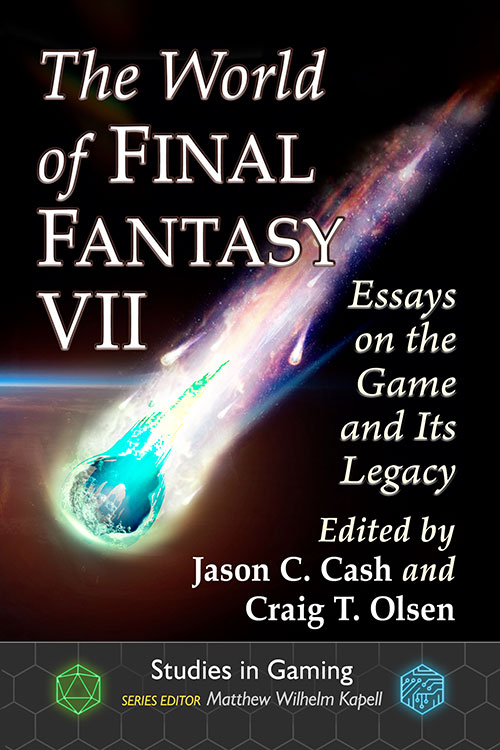
Coming Soon from McFarland: The World of Final Fantasy VII Essays on the Game and Its Legacy


Due late 2022/early 2023. Further details and pre-ordering information are available from McFarland's website at this link.

The World of Final Fantasy VII: Essays on the Game and Its Legacy


Bibliographic Details

Edited by Jason C. Cash and Craig T. Olsen. Series Editor Matthew Wilhelm Kapell

Format: softcover (6 x 9)

Copyright Date: 2022

pISBN: 978-1-4766-8186-3

eISBN: 978-1-4766-4725-8

Imprint: McFarland

Series: Studies in Gaming


About the Book

Final Fantasy VII altered the course of video game history when it was released in 1997 on Sony’s PlayStation system. It converted the Japanese role-playing game into an international gaming standard with enhanced gameplay, spectacular cutscenes and a vast narrative involving an iconic cast. In the decades after its release, the Final Fantasy VII franchise has grown to encompass a number of video game sequels, prequels, a feature-length film, a novel and a multi-volume remake series.

This volume, the first edited collection of essays devoted only to the world of Final Fantasy VII, blends scholarly rigor with fan passion in order to identify the elements that keep Final Fantasy VII current and exciting for players. Some essays specifically address the game’s perennially relevant themes and scenarios, ranging from environmental consciousness to economic inequity and posthumanism. Others examine the mechanisms used to immerse the player or to improve the narrative. Finally, there are several essays devoted specifically to the game’s legacy, from its influence on later games to its characters’ many crossovers and cameos.


About the Author(s)

Jason C. Cash is an associate professor at SUNY Delhi, where he teaches literature, composition, and film. His research interests include Irish fiction and video game narrative. He lives in Oneonta, New York.


Craig T. Olsen is an associate professor and director of the writing center at the University of Arkansas at Monticello. His areas of research include gaming literacy, music and storytelling within video games, multimodality, digital spaces, writing centers, and creative rhetoric.


Series editor Matthew Wilhelm Kapell lives in Brooklyn and teaches American studies, anthropology, and writing at Pace University.

Thursday, August 25, 2022

Hughes on The Northman in Arthuriana

From the latest issue of Arthuriana:

Hughes, Shaun F.D. "Some Thoughts on The Northman (2022)." Arthuriana, vol. 32 no. 2, 2022, p. 89-101. Project MUSE, doi:10.1353/art.2022.0014.

Tuesday, August 23, 2022

New Essay: Manning on Joan the Woman

My thanks to Scott Manning for the head's up on this:

Manning, Scott. “Joan of Arc’s Gunpowder Artillery in Cecil B. DeMille’s Joan the Woman (1916).” Film & History, vol. 52, no. 1, Summer 2022, pp. 18-31. Project MUSE, https://muse.jhu.edu/article/862227.


Saturday, June 18, 2022

Coming Soon: Dragon's Lair and the Fantasy of Interactivity


Coming Soon from Lexington Books:

Dragon's Lair and the Fantasy of Interactivity

M J CLARKE

Lexington Books

Pages: 150 • Trim: 6 x 9

978-1-7936-3603-4 • Hardback • July 2022 • $95.00 • (£73.00)

978-1-7936-3604-1 • eBook • June 2022 • $45.00 • (£35.00)

Further details and ordering at https://rowman.com/ISBN/9781793636034/Dragon's-Lair-and-the-Fantasy-of-Interactivity.


Perhaps no arcade game is so nostalgically remembered, yet so critically bemoaned, as Dragon’s Lair. A bit of a technological neanderthal, the game implemented a unique combination of videogame components and home video replay, garnering great popular media and user attention in a moment of contracted economic returns and popularity for the videogame arcade business. But subsequently, writers and critics have cast the game aside as a cautionary tale of bad game design. In Dragon’s Lair and the Fantasy of Interactivity, MJ Clarke revives Dragon’s Lair as a fascinating textual experiment interlaced with powerful industrial strategies, institutional discourse, and textual desires around key notions of interactivity and fantasy. Constructing a multifaceted historical study of the game that considers its design, its makers, its recording medium, and its in-game imagery, Clarke suggests that the more appropriate metaphor for Dragon’s Lair is not that of a neanderthal, but a socio-technical network, infusing and advancing debates about the production and consumption of new screen technologies. Far from being the gaming failure posited by evolutionary-minded lay critics, Clarke argues, Dragon’s Lair offers a fascinating provisional solution to still-unsettled questions about screen media.


Table of Contents:

Acknowledgments

Introduction

Chapter 1: Dragon's Lair: The Hardware

Chapter 2: Dragon's Lair: The Business

Chapter 3: Dragon's Lair: The Disc

Chapter 4: Dragon's Lair: The Fantasy

References

About the Author


Author Information:

MJ Clarke is associate professor in TV, film, and media studies at California State University, Los Angeles.


Friday, June 17, 2022

Recent Book: Shakespeare’s Serial Returns in Complex TV


Shakespeare’s Serial Returns in Complex TV

Authors:  Christina Wald

Palgrave Macmillan, 2020

Available in hardcover and as an ebook

Full details at https://link.springer.com/book/10.1007/978-3-030-46851-4


Traces Shakespearean influences on, and engagements in, contemporary TV series

Demonstrates how the serial complexity of current TV shows helps us understand the dramaturgical serialisations in Shakespeare’s plays

Discusses a range of adaptational strategies that range from deliberate rewritings to ‘non-adaptations' (i.e. to unintentional returns of Shakespearean plots, characters, and motifs)

Part of the book series: Reproducing Shakespeare (RESH)


About this book

This book examines how Shakespeare’s plays resurface in current complex TV series. Its four case studies bring together The Tempest and the science fiction-Western Westworld, King Lear and the satirical dynastic drama of Succession, Hamlet and the legal thriller Black Earth Rising, as well as Coriolanus and the political thriller Homeland. The comparative readings ask what new insights the twenty-first-century remediations may grant us into Shakespeare’s texts and, vice versa, how Shakespearean returns help us understand topical concerns negotiated in the series, such as artificial intelligence, the safeguarding of democracy, terrorism, and postcolonial justice. This study also proposes that the dramaturgical seriality typical of complex TV allows insights into the seriality Shakespeare employed in structuring his plays. Discussing a broad spectrum of adaptational constellations and establishing key characteristics of the new adaptational aggregate of serial Shakespeare, it seeks to initiate a dialogue between Shakespeare studies, adaptation studies, and TV studies.


Saturday, September 11, 2021

New from Oxford UP - The Oxford Handbook of Music and Medievalism

Worth a look for medievalism on screen:
 

The Oxford Handbook of Music and Medievalism

Edited by Stephen C. Meyer and Kirsten Yri 
 
 
Oxford Handbooks
 
Presents a cross-section of a diverse and growing area of study
Draws connections between musical styles and eras
Approaches topics from multiple disciplinary and thematic perspective


$175.00 (Hardcover)
 
Also Available As: Ebook

Published: 02 March 2020

848 Pages | 86 musical examples; 34 illustrations

6-3/4 x 9-3/4 inches

ISBN: 9780190658441


Description

The Oxford Handbook of Music and Medievalism provides a snapshot of the diverse ways in which medievalism--the retrospective immersion in the images, sounds, narratives, and ideologies of the European Middle Ages--powerfully transforms many of the varied musical traditions of the last two centuries. Thirty-three chapters from an international group of scholars explore topics ranging from the representation of the Middle Ages in nineteenth-century opera to medievalism in contemporary video game music, thereby connecting disparate musical forms across typical musicological boundaries of chronology and geography. While some chapters focus on key medievalist works such as Orff's Carmina Burana or Peter Jackson's Lord of the Rings films, others explore medievalism in the oeuvre of a single composer (e.g. Richard Wagner or Arvo Pärt) or musical group (e.g. Led Zeppelin). The topics of the individual chapters include both well-known works such as John Boorman's film Excalibur and also less familiar examples such as Eduard Lalo's Le Roi d'Ys. The authors of the chapters approach their material from a wide array of disciplinary perspectives, including historical musicology, popular music studies, music theory, and film studies, examining the intersections of medievalism with nationalism, romanticism, ideology, nature, feminism, or spiritualism. Taken together, the contents of the Handbook develop new critical insights that venture outside traditional methodological constraints and provide a capstone and point of departure for future scholarship on music and medievalism.


Table of Contents


Introduction [Stephen Meyer and Kirsten Yri] 

Section 1: Romanticizing the Medieval: The Longing for the Middle Ages in the Nineteenth Century
1. Medievalisms in Early Nineteenth-Century German Thought [Laura K. T. Stokes]
2. From Knight Errant to Family Man: Romantic Medievalism and Domesticity in Brahms's Romanzen aus L. Tieck's Schöne Magelone, op. 33 (1865, 1869) [Marie Sumner Lott]
3. Liszt's Medievalist Modernism [Balázs Mikusi]
4. Soldiers and Censors: Verdi's Medieval Imagination [Liana Püschel]
5. The Distant Past as Mirror and Metaphor:ÂPortraying Medievalism in Historical French Grand Operas [Diana Hallman]
6. Medievalism and Regionalist Identity in Lalo's Le Roi d'Ys [Elinor Olin]
7. Romantic Medievalist Nationalism in Schumann's Genoveva, Then and Now [Michael S. Richardson]
8. The Middle Ages in Richard Wagner's Music Dramas [Barbara Eichner] 

Section 2: Performing the Middle Ages
9. Medievalism at the University: Collegia and Choral Societies [Jacob Sagrans]
10. Medieval Folk in the Revivals of David Munrow [Edward Breen]
11. Re-sounding Carl Dreyer's La Passion de Jeanne d'Arc [Donald Greig] 

Section 3: Medievalism and Compositional Practice in the Twentieth Century
12. Medievalism and Anti-Romanticism in Carl Orff's Carmina Burana [Kirsten Yri]
13. Past Tense: Creative Medievalism in the Music of Margaret Lucy Wilkins [Lisa Colton]
14. Hucbald's Fifths and Vaughan Williams's Mass: The New Medieval in Britain Between the Wars [Deborah Heckert]
15. The Return of Ars subtilior?: Rhythmic Complexity and Appeal of Codex Chantilly Six Hundred Years Hence [Aleksandra Vojcic]
16. Miserere: Arvo Pärt and the Medieval Present[Laura Dolp]
17. The Postmodern Troubadour [Anne Stone] 

Section 4: Reimagining the Medieval Woman
18. Tolling Bells and Otherworldly Voices: Joan of Arc's Sonic World in the Early Twentieth Century [Elizabeth Dister]
19. Medievalism and Rued Langgaard's Romantic Image of Queen Dagmar [Nils Holger-Petersen]
20. Nature, Vision, and Light in Vision-Aus dem Leben der Hildegard von Bingen [Jennifer Bain]
21. Disciplining Guinevere: Courtly Love and the Arthurian Tradition from Henry Purcell to Donovan Leitch [Gillian L. Gower] 

Section 5: Echoes of the Middle Ages in Folk, Rock, and Metal
22. Early Music and Popular Music: Medievalism, Nostalgia, and the Beatles [Elizabeth Upton]
23. "Ramble On": Medievalism as Nostalgic Practice in Led Zeppelin's use of J. R. R. Tolkien [Caitlin Carlos]
24. A Gothic Romance: Neomedieval Echoes of Fin'amor in Gothic and Doom Metal [Ross Hagen]
25. Viking Metal [Simon Trafford]
26. Medievalism and Identity Construction in Pagan Folk Music [Scott R. Troyer] 

Section 6: Medievalism of the Screen
27. From the Music of the Ainur to the Music of the Voiceover: Sounding Medievalism in The Lord of the Rings [Stephen C. Meyer]
28. Faith, Fear, Silence and Music in Ingmar Bergman's Medieval Vision of The Virgin Spring and The Seventh Seal [Alexis Luko]
29. Hope Against Fate or Fata Morgana? Music and Mythopoiesis in Boorman's Excalibur [David Clem]
30. The Many Musical Medievalisms of Disney [John Haines]
31. Evil Medieval: Chant and the New Dark Spirituality of Vietnam-Era Film in America [James Deaville]
32. Fantasy Medievalism and Screen Media[James Cook]
33. Gaming the Medievalist World in Harry Potter [Karen M. Cook]


Author Information


Stephen C. Meyer is Professor of Musicology at the University of Cincinnati's College-Conservatory of Music. He is the author of Carl Maria von Weber and the Search for a German Opera (2003) and Epic Sound: Music in Postwar Hollywood Biblical Films (2015) as well as numerous articles on topics ranging from nineteenth-century German opera to film music to the history of recorded sound. He is editor of Music in Epic Film: Listening to Spectacle (2016), and from 2014 to 2018 he served as the Editor-in-Chief for the Journal of Music History Pedagogy.

Kirsten Yri is Associate Professor of Musicology at the Faculty of Music at Wilfrid Laurier University in Canada. She has published widely on the role of the early music revival and the intersections between music and medievalism in American Music, Intersections, Early Music, and Women and Music. Her work on medievalism and rock music (Dead Can Dance, Black Sabbath, and Corvus Corax) has been published in Current Musicology, Popular Music, and Postmedieval. Her recent research examines parody, gender, and social programs in Carl Orff's Trionfi against a context of German contemporary literary and philosophical debates.
Contributors:


Jennifer Bain, Professor of Music, Dalhousie University

Edward Breen, Coordinator of the Music Department, The City Literary Institute, London

Caitlin Vaughn Carlos, Adjunct Faculty, Chapman University

David Clem, Instructor of Music History, Greatbatch School of Music, Houghton College

Lisa Colton, Reader in Musicology, University of Huddersfield

James Cook, Lecturer in Early Music, University of Edinburgh

Karen M. Cook, Assistant Professor of Music History, The Hartt School of the University of Hartford

James Deaville, Professor, School for Studies in Art & Culture: Music at Carleton University

Elizabeth Dister, Webster University Faculty Development Center

Laura Dolp, Associate Professor, Montclair State University

Barbara Eichner, Senior Lecturer in Music, Oxford Brookes University

Gillian L. Gower, Visiting Assistant Professor of Musicology, Southern Methodist University

Donald Greig, Founding Member, The Orlando Consort

Ross Hagen, Assistant Professor of Music Studies, Utah Valley University

John Haines, Professor of Music and Medieval Studies, University of Toronto

Diana R. Hallman, Associate Professor, University of Kentucky

Deborah Heckert, Department of Music, Stony Brook University

Alexis Luko, Associate Professor of Music, School for Studies in Art & Culture and the College of the Humanities at Carleton University

Stephen Meyer, Professor of Musicology, College-Conservatory of Music of the University of Cincinnati

Balázs Mikusi, Head of Music, National Széchényi Library in Budapest since 2009

Elinor Olin, Music History Faculty, Northern Illinois University

Nils Holger Petersen, Associate Professor emeritus of Church History, University of Copenhagen

Liana Püschel, Teaching Assistant of Musicology, Università degli studi di Torino, Humanities Faculty

Michael S. Richardson, Assistant Professor of Musicology, University of St. Thomas

Jacob Sagrans, Independent Scholar, Editor, Administrator, and Choral Performer

Laura K. T. Stokes, Performing Arts Librarian and Visiting Lecturer in Music, Brown University

Anne Stone, Associate Professor of Musicology, Graduate Center of the City University of New York

Marie Sumner Lott, Associate Professor of Music History, Georgia State University in Atlanta

Simon Trafford, Lecturer in Medieval History, Institute of Historical Research, University of London

Scott R. Troyer, Ph.D. candidate, University of Cincinnati College-Conservatory of Music

Elizabeth Randell Upton, Associate Professor of Musicology, UCLA

Aleksandra Vojcic, Associate Professor of Music Theory, The University of Michigan

Kirsten Yri, Associate Professor of Musicology, Wilfrid Laurier University 


Saturday, July 17, 2021

Now in paperback: From Medievalism to Early-Modernism

Out now in paperback. Definitely worth a look.

From Medievalism to Early-Modernism: Adapting the English Past 

Edited by Marina Gerzic and Aidan Norrie

Copyright Year 2019

Paperback ISBN 9780367664725

Published September 30, 2020 by Routledge
284 Pages 

Available at https://www.routledge.com/From-Medievalism-to-Early-Modernism-Adapting-the-English-Past/Gerzic-Norrie/p/book/9780367664725.


Book Description

From Medievalism to Early-Modernism: Adapting the English Past is a collection of essays that both analyses the historical and cultural medieval and early modern past, and engages with the medievalism and early-modernism—a new term introduced in this collection—present in contemporary popular culture. By focusing on often overlooked uses of the past in contemporary culture—such as the allusions to John Webster’s The Duchess of Malfi (1623) in J.K. Rowling’s Harry Potter books, and the impact of intertextual references and internet fandom on the BBC’s The Hollow Crown: The Wars of the Roses—the contributors illustrate how cinematic, televisual, artistic, and literary depictions of the historical and cultural past not only re-purpose the past in varying ways, but also build on a history of adaptations that audiences have come to know and expect. From Medievalism to Early-Modernism: Adapting the English Past analyses the way that the medieval and early modern periods are used in modern adaptations, and how these adaptations both reflect contemporary concerns, and engage with a history of intertextuality and intervisuality.


Table of Contents


Acknowledgements

List of Figures

Notes on Contributors


1. Introduction: Medievalism and Early-Modernism in Adaptations of the English Past

Marina Gerzic and Aidan Norrie


Section I: Cultural Medievalism and Early-Modernism

2. Wonder Woman and the Nine Ladies Worthy: The Male Gaze and what it takes to be a ‘Worthy Woman’

Simone Celine Marshall


3. The King, the Sword, and the Stone: The Recent Afterlives of King Arthur

Sarah Gordon


4. Brand Chaucer: The Poet and the Nation

Martin Laidlaw


5. Moving between Life and Death: Horror films and the Medieval Walking Corpse

Polina Ignatova


6. From Cabaret to Gladiator: Refiguring Masculinity in Julie Taymor’s Titus

Marina Gerzic


7. "There’s My Exchange": The Hogarth Shakespeare

Sheila T. Cavanagh


8. Bloody Brothers and Suffering Sisters: The Duchess of Malfi and Harry Potter

Lisa Hopkins


Section II: Historical Medievalism and Early-Modernism

9. Playing in a Virtual Medieval World: Video Game Adaptations of England through Role-play

Ben Redder


10. "I can piss on Calais from Dover": Adaptation and Medievalism in Graphic Novel Depictions of the Hundred Years’ War (1337–1453)

Iain A. MacInnes


11. Beyond "tits and dragons": Medievalism, Medieval History, and Perceptions in Game of Thrones

Hilary Jane Locke


12. Re-fashioning Richard III: Intertextuality, Fandom, and the (Mobile) Body in The Hollow Crown: The Wars of the Roses

Marina Gerzic


13. The Many Afterlives of Elizabeth Barton

Annie Blachly


14. The Queen, the Bishop, the Virgin, and the Cross: Catholicism versus Protestantism in Elizabeth

Aidan Norrie


15. "Unseen but very evident": Ghosts, Hauntings, and the Civil War Past

Michael Durrant


Index


Editor(s) Biography


Marina Gerzic works for the Centre for Medieval and Early Modern Studies at The University of Western Australia, in both research and administrative roles. She also works as the Executive Administrator for the Australian and New Zealand Association for Medieval and Early Modern Studies, and as the editorial assistant for the academic journal Parergon. She has published articles on film and adaptation theory, Shakespeare, pedagogy, cinematic music, cultural studies, science fiction, comics and graphic novels, and children’s literature.


Aidan Norrie is a historian of monarchy, and is currently a Chancellor’s International Scholar in the Centre for the Study of the Renaissance at The University of Warwick. He is the editor, with Lisa Hopkins, of Women on the Edge in Early Modern Europe (Amsterdam University Press); and, with Mark Houlahan, of On the Edge of Early Modern English Drama (MIP University Press).


Saturday, June 26, 2021

Coming Soon from Mcfarland: Knights Templar in Popular Culture

Just announced:

The Knights Templar in Popular Culture: Films, Video Games and Fan Tourism

Full details at https://mcfarlandbooks.com/product/the-knights-templar-in-popular-culture/

Patrick Masters
New 2021
Not Yet Published

Available for pre-order at $39.95

Format: softcover (6 x 9)
Pages: TBA
Bibliographic Info: appendix, bibliography, index
Copyright Date: 2021
pISBN: 978-1-4766-8197-9
eISBN: 978-1-4766-4571-1
Imprint: McFarland


Patrick Masters has published writings on the Knights Templar in The Conversation and The Independent. He lives in the UK.

Monday, February 1, 2021

Recent Scholarship: Brode and Brode's It's the Disney Version!

 I finally picked up a copy of this intriguing collection. 


Edited by Douglas Brode and Shea T. Brode

Rowman & Littlefield Publishers
Pages: 254 • Trim: 6 x 9 
 
978-1-4422-6606-3 • Hardback • June 2016 • $95.00 • (£73.00)
978-1-4422-6607-0 • eBook • June 2016 • $90.00 • (£69.00) 
 
In 1937, the first full-length animated film produced by Walt Disney was released. Based on a fairy tale written by the Brothers Grimm, Snow White and the Seven Dwarfs was an instant success and set the stage for more film adaptations over the next several decades. From animated features like and Bambi to live action films such as Mary Poppins, Disney repeatedly turned to literary sources for inspiration—a tradition the Disney studios continues well into the twenty-first century.

In
It’s the Disney Version!: Popular Cinema and Literary Classics, Douglas Brode and Shea T. Brode have collected essays that consider the relationship between a Disney film and the source material from which it was drawn. Analytic yet accessible, these essays provide a wide-ranging study of the term “The Disney Version” and what it conveys to viewers. Among the works discussed in this volume are Alice in Wonderland, Mary Poppins, Pinocchio,Sleeping Beauty, Tarzan, and Winnie the Pooh.

In these intriguing essays, contributors to this volume offer close textual analyses of both the original work and of the Disney counterpart. Featuring articles that consider both positive and negative elements that can be found in the studio’s
output, It’s the Disney Version!: Popular Cinema and Literary Classics will be of interest to scholars and students of film, as well as the diehard Disney fan.


Contents (from WorldCat):

Introduction: once upon a time at the movies / Douglas Brode --

"And they lived happily ever after?": Disney's animated adaptation of Snow White and the seven dwarfs (1937) and Fleischers' Gulliver's travels / David McGowan --

Marionette as metaphor: Pinocchio and evolving attitudes toward education / Jean-Marie Apostolides --

Here be gay dragons: queer allegory and Disney's The reluctant dragon / Tison Pugh --

Uncle Walt's Uncle Remus: Disney's distortion of Harris's hero / Peggy A. Russo --

"Glory in the flower": Disneyfying Bambi / David Payne --

Through the cinematic looking glass: Walt Disney's 1951 animated Alice and Tim Burton's 2010 film / Sarah Boslaugh --

Walt Disney and Robert Louis Stevenson: Haskin's Treasure island or Stevenson's Kidnapped? / Scott Allen Nollen --

Of medieval ballads and movie musicals: Walt Disney and the Robin Hood legend / Shea T. Brode with Douglas Brode --

"Do you believe in fairies?": Peter Pan, Walt Disney, and me / Elizabeth Bell --

"In God's good time": Walt Disney and 1950s Cold War culture / Cynthia J. Miller and A. Bowdoin Van Riper --

Perchance to dream: a narrative analysis of Disney's Sleeping beauty / Alexis Finnerty with Douglas Brode --

"It's a jungle out there, kid!": Walt Disney and the American 1960s / Greg Metcalf --

"Higitus! figitus!": of Merlin and Disney magic / Susan Aronstein --

"This is not the Mary Poppins I know!": P.L. Travers goes to Hollywood / David S. and Olga Silverman --

The wonderful worlds of Dickens and Disney: animated adaptations of Oliver Twist and A Christmas carol / Shari Hodges Holt --

The tao at Pooh corner: Disney's portrayal of a very philosophical bear / Anne Collins Smith and Owen M. Smith --

From icon to Disneyfication: a mermaid's aesthetic journey / Finn Hauberg Mortensen --

Pocahontas as Disney princess: history, legend, literature, and movie mythology / Kathy Merlock Jackson and Gary Edgerton --

"Driven to sin": Victor Hugo's complex vision of humanity in Disney's The hunchback of Notre Dame / Michael Smith --

The integrity of an ape-man: Burroughs, Disney, and the meaning of the Tarzan myth / Stanley A. Galloway.
 
 
Authors:
 
Douglas Brode teaches popular culture at Syracuse University’s Newhouse School of Public Communications, the University of Texas at San Antonio, and Our Lady of the Lake University (also in San Antonio). He has published more than 35 books, including Rod Sterling and The Twilight Zone (2009). He is the coeditor of Myth, Media, and Culture in Star Wars: An Anthology (2012) and Sex, Politics and Religion in Star Wars: An Anthology (2012), and Dracula’s Daughters: The Female Vampire on Film (2013). Brode is a contributor to the upcoming PBS-TV mini-series: American Masters: Walt Disney. Shea T. Brode has an MA in Literature and Cultural Studies from the University Autonoma in Madrid. Douglas and Shea are the coeditors of The Star Trek Universe: Franchising the Final Frontier (2015) and Gene Roddenberry’s Star Trek: The Original Cast Adventures (2015).