Showing posts with label Electronic Games. Show all posts

Thursday, July 16, 2026

CFP Between Screens: Video Games, Film, Television and Transmedia Exchange (8/7/2026)

Of potential interest:

Between Screens: Video Games, Film, Television and Transmedia Exchange


deadline for submissions:
August 7, 2026

full name / name of organization:
Dr Michael Samuel (University of Bristol) and Dr Richard Cole (University of Bristol)

contact email:
mike.samuel@bristol.ac.uk

source: https://call-for-papers.sas.upenn.edu/cfp/2026/06/25/between-screens-video-games-film-television-and-transmedia-exchange


Between Screens: Video Games, Film, Television and Transmedia Exchange

Edited by Dr Michael Samuel and Dr Richard Cole

Adaptation is a dialogic process, a creative exchange across content production and context rather than an attempt at fidelity. Recent trends in adaptation studies reflect this complexity. Videogames exist within a vast ecosystem of transmedia storytelling and experiences, yet scholarship on adaptation and video games remains limited.

This collection is a response to this gap. Our aim with Between Screens is to reframe the conversation about the relationship between videogames and other screen media, inviting approaches that emphasise the adaptive process and illuminate the formal, narratological, technological, industrial and cultural dimensions of transmedia adaptation. How do stories and characters, mechanics, aesthetics and meanings transform as they move between videogames and other media? How do adaptive practices acknowledge or resist these differences? What role do intellectual property, industrial consolidation and transmedia marketing play in shaping adaptive choices and audience experiences? What theoretical frameworks can help us move further beyond fidelity criticism? How can we better understand adaptation as a two-way process that reveals broader truths about media convergence, storytelling possibilities, and the evolving nature of entertainment industries? These are just a flavour of the questions this collection will address.

At this stage, we are prioritising submissions that address the following topics:

1. Histories of game adaptation — How have adaptation practices evolved from early arcade games and home console ports to contemporary transmedia franchises that start or end with games?
2. Narrative and mechanical translation — How do narrative structures, game mechanics, and interactive elements translate (or resist translation) across media?
3. Aesthetic and stylistic adaptation — What is the relationship between visual design, sound design, cinematic language, and ludic form?
4. Industrial and economic factors — How have studios, licensing agreements, and IP ownership shaped adaptive decisions?
5. Gender, representation, and adaptation — How does adaptation shape or reshape character representation, narrative arcs, and thematic content?
6. Transmedia franchises and worldbuilding — The role of adaptation in constructing interoperable fictional worlds across multiple platforms
7. Audiences and reception — How do fans, critics, and players interpret and engage with adapted works across media?

Please email a chapter abstract (300-500 words) and a brief author biography (100 words maximum) to Dr Michael Samuel (mike.samuel@bristol.ac.uk ) and Dr Richard Cole (Richard.Cole@bristol.ac.uk) by 7 August 2026. In your email, please indicate which topic/question from above that your proposed chapter will address. The book proposal is currently under consideration by Palgrave. We therefore anticipate that final chapters will be between 6,500 and 8000 words (including notes and references). All submissions must be original, previously unpublished work. Please use Harvard in-text referencing formatting for citations. Please include the subject line ‘Between Screens’ with your email.
If you have any further questions, please don’t hesitate to contact us (email both of us).

Editor Bios
Dr Michael Samuel is Senior Lecturer in Digital Film and TV Studies and co-director of the Bristol Digital Game Lab at the University of Bristol.
Dr Richard Cole is Senior Lecturer in Digital Futures and co-director of the Bristol Digital Game Lab at the University of Bristol.


Last updated June 25, 2026

Friday, May 9, 2025

CFP We Live Again! Disney's Gargoyles as an Evolving Transmedia Text (7/15/2025; NEPCA online 10/9-11/2025)

With apologies for cross-posting.

We Live Again! Disney's Gargoyles as an Evolving Transmedia Text

Co-sponsored by the Monsters & the Monstrous Area and Disney Studies Area

Call for Papers for 2025 Virtual Conference of the Northeast Popular Culture Association (NEPCA)

Thursday, 9 October, to Saturday, 11 October, 2025

Submissions are open until Tuesday, 15 July by 5 PM EDT


Conceived by creator Greg Weisman, Disney’s Gargoyles began as a television series in the 1990s and has been expanded over the decades through action figures, books, clothing, collectibles, comics, conventions, fan art, fanfiction, games, puzzles, and recurrent rumors of a live-action reboot. Although now over thirty years old, Gargoyles has remained incredibly popular since its initial debut, yet, while other aspects of Disney Studies are flourishing, scholars have mostly neglected the series. Therefore, we seek in this session to offer some critical attention to Gargoyles and its various adaptations and continuations. 

Proposals should display some knowledge of the history and scope of the series, its adaptation history, and its ongoing evolution. We encourage you to make use of the resource guide provided at https://tinyurl.com/WeLiveAgainRG in formulating your approach. 


To submit a proposal, please review the requirements and procedure from NEPCA’s main conference page at https://www.northeastpca.org/conference. Proposals should be approximately 250 words; an academic biographical statement (75 words or less) is also requested. Payment of registration and membership fees will be required to present. More details on exact costs will be forthcoming. 


Direct submissions to the Monsters & the Monstrous Area can be made at https://cfp.sched.com/speaker/sTP9T9X3cW/event. Address any questions or concerns to the area chair at popular.preternaturaliana@gmail.com. 


Further information on the Monsters & the Monstrous Area can be accessed on our blog Popular Preternaturaliana: Studying the Monstrous in Popular Culture at https://popularpreternaturaliana.blogspot.com/.  

Further information on the Northeast Popular Culture Association (NEPCA) can be accessed from our new website at https://www.northeastpca.org/. 


Sunday, February 9, 2025

Sponsored Sessions on Animation (and More) for NeMLA 2025

Cross-posted from the Mass Mediævalisms blog:

We are organizing the following sessions for the 56th Annual Convention of the Northeast Modern Language Association to be held in Philadelphia, 6-9 March. The full schedule is available online and registration is required to attend. 


Thursday, Mar 6 - Track 4 (02:15-04:15 PM)

4.12 Saving the Day for Medieval Studies: Using Comics for Teaching the Middle Ages (Roundtable)
Chair: Michael Torregrossa, Bristol Community College
Chair: Karen Casebier, University of Tennessee-Chattanooga
Location: 402 (Media Equipped)
Pedagogy & Professional & Cultural Studies and Media Studies

"The Medieval Comics Project: Ongoing Efforts to Expand the Field of Medieval Comics Scholarship" Michael Torregrossa, Bristol Community College

"From Borders to Panels: Integrating Comic Books into Medieval Studies Pedagogy" Rachael Warmington, Seton Hall University

"Reshaping Literary Canon: Graphic Novels as the Future of Classics" Derek Castle, University of New Hampshire

"Marvel 1602 and its Connection to the Scientific Enlightenment" Madison Cothern, University of Memphis


Sunday, Mar 9 - Track 22 (08:15-10:15 AM)


22.20 (Re)Animating the Middle Ages: Adapting the Medieval in Animated Media (Seminar)
Chair: Michael Torregrossa, Bristol Community College
Chair: Karen Casebier, University of Tennessee-Chattanooga
Location: 410 (Media Equipped)
Cultural Studies and Media Studies & Interdisciplinary Humanities

"Animating Marie de France : Emile Mercier’s Bisclavret (2011)" Karen Casebier, University of Tennessee-Chattanooga

"The Black Knight: Women “Passing” as Knights in Children’s Entertainment" Megan Arnott, Lakehead University

"Cartoon Saloon's Wild Women: Monstrous Genders in Irish Animated Medievalism" Colin Wheeler, Kennesaw State University

"A Modern Look at Late Medieval Religion and Literacy in Obsidian Entertainment’s Pentiment" Olivia Mathers, Lehigh University

"Heresy and Crusades: How Modern Fascists Appropriated the Medieval Aesthetics of Warhammer 40k" William Weiss, Independent Scholar


Thursday, January 30, 2025

Coming Soon in Paperback - Playing the Middle Ages: Pitfalls and Potential in Modern Games

Playing the Middle Ages: Pitfalls and Potential in Modern Games

Robert Houghton (Anthology Editor)

Full details and ordering information at https://www.bloomsbury.com/us/playing-the-middle-ages-9781350242920/.


Product details

Published Sep 21 2023

Available in Hardcover / eBook / and Paperback in 2025

Extent 288

Imprint Bloomsbury Academic

Illustrations 20 bw illus

Dimensions 9 x 6 inches

Series New Directions in Medieval Studies

Publisher Bloomsbury Publishing


Description


The Middle Ages have provided rich source material for physical and digital games from Dungeons and Dragons to Assassin's Creed. This volume addresses the many ways in which different formats and genre of games represent the period. It considers the restrictions placed on these representations by the mechanical and gameplay requirements of the medium and by audience expectations of these products and the period, highlighting innovative attempts to overcome these limitations through game design and play.

Playing the Middle Ages considers a number of important and timely issues within the field including: one, the connection between medieval games and political nationalistic rhetoric; two, trends in the presentation of religion, warfare and other aspects of medieval society and their connection to modern culture; three, the problematic representations of race; and four, the place of gender and sexuality within these games and the broader gaming community.

The book draws on the experience of a wide-ranging and international group of academics across disciplines and from games designers. Through this combination of expertise, it provides a unique perspective on the representation of the Middle Ages in modern games and drives key discussions in the fields of history and game design.


Table of Contents


List of Figures

List of Contributors

1 The Middle Ages in Modern Games: An Adolescent Field Robert Houghton, University of Winchester, UK

2 Unbending Medievalisms: Finding counterfactual history in sandbox games set in the Middle Ages, Ylva Grufstedt, Malmö University, Sweden

3 Playing the Sonic Past: reflections on sound in medieval-themed video games, Mariana López, University of York, UK

4 Medieval Sounds, Sounding Medieval, Karen M. Cook, University of Hartford, USA

5 All on board for the Crusades, Gordon Smith, University of Edinburgh, UK

6 Subverting the Valiant Crusader: The Sarafan in the Legacy of Kain: Soul Reaver series, Liam McLeod, University of Birmingham, UK

7 Making Friendships, Breaking Friendships: Exploring Viking-Age Social Roles Through Player Strategy in A Feast for Odin, Adam Bierstedt, University of Reykjavik, Iceland

8 Abandoning Civilization: Medieval Rulership in Crusader Kings III, Reigns, and Mount and Blade: Warband, Robert Houghton, University of Winchester, UK

9 Joan of Arc, the Meme of Orléans: The Playful Liberties Taken with History by the Age of Empires 2 Gaming Community, Jonathan Bloch, Independent Scholar

10 On the Postcolonial Analysis of 'Indians' in Age of Empires II: A Theory of “Ethical Programs” Behind Postcolonial Criticisms of Videogames, Neil Nagwekar

11 Virtually (De)Colonized: Racial Identity and Colonialism in the Middle Ages and as Depicted in Kingdom Come: Deliverance, Innocence: A Plague Tale, The Elder Scrolls, and Black Desert Online, Johansen Quijano, University of Texas at Arlington, USA

12 Representations of Medieval Gender Archetypes in Fantasy Role-Playing Games, Markus Eldegard Mindrebø, Royal Holloway, UK

13 Ashen, Hollow, Cursed: Fragile Knighthood in the Dark Souls Series and its Medieval Antecedents, Patrick Butler, University of Connecticut, USA

14 Matilda of Canossa and Crusader Kings II: (Papal) Warrior Princess, Blair Apgar, University of York, UK

Index


Sunday, April 2, 2023

Check It Out: Neomedievalism, Popular Culture, and the Academy


Finally had a chance to review this. Looks like a great resource. 


Neomedievalism, Popular Culture, and the Academy: From Tolkien to Game of Thrones


by KellyAnn Fitzpatrick

Full details and ordering information from the publisher is available at this link.


TITLE DETAILS

244 Pages

21.6 x 13.8 cm

Series: Medievalism
Series Vol. Number: 16

Imprint: D.S.Brewer


Hardcover
9781843845416
October 2019
$95.00 / £65.00

Ebook (EPDF)
9781787447028
October 2019
$29.95 / £24.99

Ebook (EPUB)
9781800109308
October 2019
$29.95 / £24.99


Description


The medieval in the modern world is here explored in a variety of media, from film and book to gaming.

Medievalism - the ways in which post-medieval societies perceive, interpret, reimagine, or appropriate the Middle Ages - permeates popular culture. From Disney princesses to Game of Thrones, medieval fairs to World of Warcraft, contemporary culture keeps finding new ways to reinvent and repackage the period. Medievalism itself, then, continues to evolve while it is also subject to technological advances, prominent invocations in political discourse, and the changing priorities of the academy. This has led some scholars to adopt the term "neomedievalism", a concept originating in part from the work of the late Umberto Eco, which calls for new avenues of inquiry into the way we think about the medieval.
This book examines recent evolutions of (neo)medievalism across multiple media, from Tolkien's Lord of the Rings to the film Beowulf and medieval gaming. These evolutions can take the form of what one might consider to be pop culture objects of critique (art, commodity, amusement park, video game) or academic tools of critique (monographs, articles, lectures, university seminars). It is by reconciling these seemingly disparate forms that we can better understand the continual, interconnected, and often politicized reinvention of the Middle Ages in both popular and academic culture.


Contents

Introduction
1. The Academy and the Making of Neomedievalism
2. Tolkien: From Medieval Studies to Medievalist Fantasy
3. Hollywood Genders the Neomedieval: Sleeping Beauty/Beowulf/Maleficent
4. Game of Thrones: Neomedievalism and the Myths of Inheritance
5. Magic: The Gathering and the Markets of Neomedievalism
6. Digital Gaming: Coding a Connective Neomedievalism
Bibliography


Author


KELLYANN FITZPATRICK is an affiliated researcher at the Georgia Institute of Technology.


Tuesday, January 17, 2023

CFP Science Fiction and Fantasy Gaming Conference (1/20/2023; Online 2/27-28/2023)


Cross-posted from the SFRA list. Note the impending deadline.

Call for Papers: Science Fiction and Fantasy Gaming Conference


Please see information below about MultiPlay Gaming Network's upcoming Science Fiction and Fantasy Gaming Conference on the 27th and 28th February 2023.

MultiPlay is excited to host a two-day online conference on science fiction and fantasy in games! The conference intends to cover a broad range of anything regarding science fiction, fantasy, or speculative fiction in gaming.

Day One will thematically focus on Science Fiction and Day Two will thematically focus on Fantasy. Both days will be online conferences hosted via Windows Teams. Presentations will last twenty minutes, with a ten-minute Q&A at the end of each session.

We are currently seeking abstracts related to anything regarding science fiction or fantasy in video games of no more than 300 words, including references using the Harvard reference style guide, to be accompanied with a 100 word author biography.

We will also accept abstracts dealing with games that blur the two genres, or any sort of speculative fiction element in games, and they will be given a slot on either of the two days if accepted. We will also consider abstracts that deal with analog gaming instead of digital

Please send all abstracts to networkmultiplay@gmail.com with the heading ‘SFF Conference’ by January 20th. This week is the final week that we are accepting abstracts for this conference!

If you have any further questions, please email networkmultiplay@gmail.com


Wednesday, January 4, 2023

Out Now: Playing the Crusades


New from Routledge:

Playing the Crusades

Engaging the Crusades, Volume Five


Edited By Robert Houghton

Copyright Year 2021

Full details and ordering information available at this link. 

Paperback
$18.36
Hardback
$47.96
eBook
$18.36


ISBN 9780367716356 (pb)
Published September 26, 2022 by Routledge
122 Pages


Book Description


Engaging the Crusades is a series of volumes which offer windows into a newly emerging field of historical study: the memory and legacy of the crusades. Together these volumes examine the reasons behind the enduring resonance of the crusades and present the memory of crusading in the modern period as a productive, exciting, and much needed area of investigation.

This volume considers the appearance and use of the crusades in modern games; demonstrating that popular memory of the crusades is intrinsically and mutually linked with the design and play of these games. The essays engage with uses of crusading rhetoric and imagery within a range of genres – including roleplaying, action, strategy, and casual games – and from a variety of theoretical perspectives drawing on gender and race studies, game design and theory, and broader discussions on medievalism. Cumulatively, the authors reveal the complex position of the crusades within digital games, highlight the impact of these games on popular understanding of the crusades, and underline the connection between the portrayal of the crusades in digital games and academic crusade historiography.

Playing the Crusades is invaluable for scholars and students interested in the crusades, popular representations of the crusades, historical games, and collective memory.


Table of Contents


Introduction: crusades and crusading in modern games

Robert Houghton


A sacred task, no cross required: the image of crusading in computer gaming-related non-Christian science fiction universes

Roland Wenskus


‘I’m not responsible for the man you are!’: crusading and masculinities in Dante’s Inferno

Katherine J. Lewis


‘Show this fool knight what it is to have no fear’: freedom and oppression in Assassin’s Creed (2007)

Oana-Alexandra Chirilă


Crusader kings too? (Mis)Representations of the crusades in strategy games

Robert Houghton


Learning to think historically: some theoretical challenges when playing the crusades


Andreas Körber, Johannes Meyer-Hamme, and Robert Houghton


Editor(s)

Biography


Robert Houghton is Senior Lecturer in Medieval History at the University of Winchester. His research focuses on religious and political relationship networks in the central Middle Ages and on representations of the medieval world in modern games. Recent publications include ‘Italian Bishops and Warfare during the Investiture Contest: The Case of Parma’ (2018) and ‘World, Structure and Play: Digital Games as Historical Research Tools’ (2018).


Saturday, October 22, 2022

Recent from McFarland: Being Dragonborn: Critical Essays on The Elder Scrolls V: Skyrim


Full details and ordering information is available from McFarland's website at this link.

Being Dragonborn: Critical Essays on The Elder Scrolls V: Skyrim


Edited by Mike Piero and Marc A. Ouellette

Series Editor Matthew Wilhelm Kapell

$29.95

Format: softcover (7 x 10)

Pages: 236

Bibliographic Info: notes, bibliography, index

Copyright Date: 2021

pISBN: 978-1-4766-7784-2

eISBN: 978-1-4766-4356-4

Imprint: McFarland

Series: Studies in Gaming


About the Book


The Elder Scrolls V: Skyrim is one of the bestselling and most influential video games of the past decade. From the return of world-threatening dragons to an ongoing civil war, the province of Skyrim is rich with adventure, lore, magic, history, and stunning vistas. Beyond its visual spectacle alone, Skyrim is an exemplary gameworld that reproduces out-of-game realities, controversies, and histories for its players. Being Dragonborn, then, comes to signify a host of ethical and ideological choices for the player, both inside and outside the gameworld. These essays show how playing Skyrim, in many ways, is akin to “playing” 21st century America with its various crises, conflicts, divisions, and inequalities. Topics covered include racial inequality and white supremacy, gender construction and misogyny, the politics of modding, rhetorics of gameplay, and narrative features.


Table of Contents


Acknowledgments v

Introduction: Skyrim as an Exemplary Gameworld

Mike Piero and Marc A. Ouellette 1


Part I: “Skyrim is our land”: Neomedievalism, Heroism and ­Ethno-Nationalist Gameplay

From Hero to Zero: Nationalistic Narratives and the Dogma of Being Dragonborn

Joshua Call and Thomas Lecaque 14

Grounding the Neomedieval Gameworld: The Dragonborn Between History and Myth

Alicia McKenzie 28

Expanding the Frontier Through War: Skyrim’s Ludic Contribution to the Frontier Myth

Brent Kice 45


Part II: “Then I took an arrow in the knee”: Agency and Alterity

Queer Harpies and Vicious Dryads: Hagravens, Spriggans and Abject Female Monstrosity in Skyrim

Sarah Stang 60

All the Wheels of Cheese: Hoarding and Collecting Behaviors in Skyrim

D’An Knowles Ball 75

Escapism as Contested Space: The Politics of Modding Skyrim

Liamog S. Drislane 91


Part III: “Sky above, voice within”: Ethics and Politics Within Skyrim’s Cosmology

Nature Versus Player: Skyrim Players and Modders as Ecological Force

Misha Grifka Wander 106

Portraits of the Neomedieval ­Family-Idyllic: Patriarchal Oikos and a Love Without Love in Skyrim

Mike Piero and Marc A. Ouellette 120

Skyrim’s Competitive Cosmology: A Fluctuating Economy of Power and Parasitic Deification

Trevor B. Williams 137

Testing Your Thu’um: Rhetoric, Violence, Uncertainty and the Dragonborn

Stephen M. Llano 154


Part IV: “Who wrote the Elder Scrolls?” Emergent Narratives and Difficult Questions

Emergent Worlds and Illusions of Agency: Worldbuilding as Design Practice in Skyrim

Wendi Sierra 172

Taking Your Time as Dragonborn: Reconciling Skyrim’s Ludic and Narrative Dimensions Through a Detective Story Typology

Andrew A. Todd 188

The Death of Paarthurnax: The “Good Temptation”?

C. Anne Engert and Tony Perrello 202


About the Contributors 221


Index 223


About the Author(s)


Mike Piero is a Professor of English at Cuyahoga Community College in Cleveland, Ohio.


Marc A. Ouellette is an award-winning educator who teaches cultural and gender studies at Old Dominion University, where he is the Learning Games Initiative Research Fellow.


Series editor Matthew Wilhelm Kapell lives in Brooklyn and teaches American studies, anthropology, and writing at Pace University.

Coming Soon from McFarland: Larsen's Science, Technology and Magic in The Witcher: A Medievalist Spin on Modern Monsters


Due late 2022/early 2023. Further details and pre-ordering information are available from McFarland's website at this link.

Science, Technology and Magic in The Witcher: A Medievalist Spin on Modern Monsters


Kristine Larsen. 

Series Editors Donald E. Palumbo and C.W. Sullivan III

Format: softcover (6 x 9)

Copyright Date: 2022

pISBN: 978-1-4766-8385-0

eISBN: 978-1-4766-4817-0

Imprint: McFarland

Series: Critical Explorations in Science Fiction and Fantasy


About the Book

As Andrzej Sapkowski was fleshing out his character Geralt of Rivia for a writing contest, he did not set out to write a science textbook—or even a work of science fiction. However, the world that Sapkowski created in his series The Witcher resulted in a valuable reflection of real-world developments in science and technology. As the Witcher books have been published across decades, the sorcery in the series acts as an extension of the modern science it grows alongside.


This book explores the fascinating entanglement of science and magic that lies at the heart of Sapkowski’s novel series and its widely popular video game and television adaptations. This is the first English-language book-length treatment of magic and science in the Witcher universe. These are examined through the lenses of politics, religion, history and mythology. Sapkowski’s richly detailed universe investigates the sociology of science and ponders some of the most pressing modern technological issues, such as genetic engineering, climate change, weapons of mass destruction, sexism, speciesism and environmentalism. Chapters explore the unsettling realization that the greatest monsters are frequently human, and their heinous acts often involve the unwitting hand of science.


About the Author(s)

Kristine Larsen is a professor of astronomy at Central Connecticut State University, where her teaching and research focus on the intersections between science and society. Her publications include numerous articles and book chapters on J.R.R. Tolkien’s uses of astronomy in his writings.


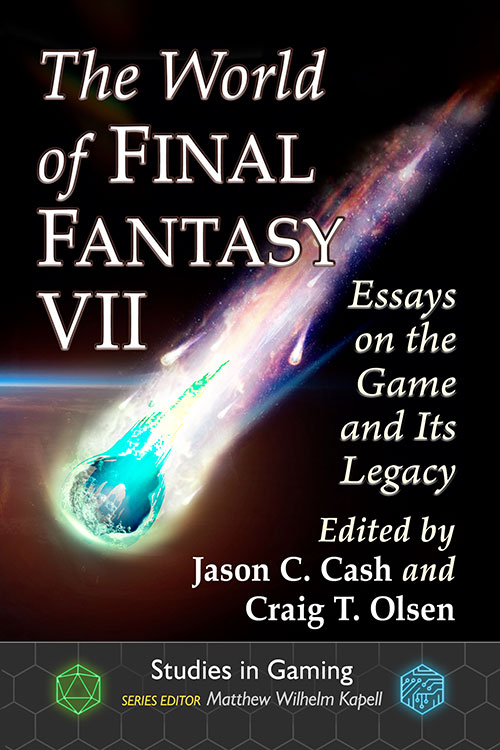
Coming Soon from McFarland: The World of Final Fantasy VII Essays on the Game and Its Legacy


Due late 2022/early 2023. Further details and pre-ordering information are available from McFarland's website at this link.

The World of Final Fantasy VII: Essays on the Game and Its Legacy


Bibliographic Details

Edited by Jason C. Cash and Craig T. Olsen. Series Editor Matthew Wilhelm Kapell

Format: softcover (6 x 9)

Copyright Date: 2022

pISBN: 978-1-4766-8186-3

eISBN: 978-1-4766-4725-8

Imprint: McFarland

Series: Studies in Gaming


About the Book

Final Fantasy VII altered the course of video game history when it was released in 1997 on Sony’s PlayStation system. It converted the Japanese role-playing game into an international gaming standard with enhanced gameplay, spectacular cutscenes and a vast narrative involving an iconic cast. In the decades after its release, the Final Fantasy VII franchise has grown to encompass a number of video game sequels, prequels, a feature-length film, a novel and a multi-volume remake series.

This volume, the first edited collection of essays devoted only to the world of Final Fantasy VII, blends scholarly rigor with fan passion in order to identify the elements that keep Final Fantasy VII current and exciting for players. Some essays specifically address the game’s perennially relevant themes and scenarios, ranging from environmental consciousness to economic inequity and posthumanism. Others examine the mechanisms used to immerse the player or to improve the narrative. Finally, there are several essays devoted specifically to the game’s legacy, from its influence on later games to its characters’ many crossovers and cameos.


About the Author(s)

Jason C. Cash is an associate professor at SUNY Delhi, where he teaches literature, composition, and film. His research interests include Irish fiction and video game narrative. He lives in Oneonta, New York.


Craig T. Olsen is an associate professor and director of the writing center at the University of Arkansas at Monticello. His areas of research include gaming literacy, music and storytelling within video games, multimodality, digital spaces, writing centers, and creative rhetoric.


Series editor Matthew Wilhelm Kapell lives in Brooklyn and teaches American studies, anthropology, and writing at Pace University.

Saturday, June 18, 2022

Coming Soon: Dragon's Lair and the Fantasy of Interactivity


Coming Soon from Lexington Books:

Dragon's Lair and the Fantasy of Interactivity

M J CLARKE

Lexington Books

Pages: 150 • Trim: 6 x 9

978-1-7936-3603-4 • Hardback • July 2022 • $95.00 • (£73.00)

978-1-7936-3604-1 • eBook • June 2022 • $45.00 • (£35.00)

Further details and ordering at https://rowman.com/ISBN/9781793636034/Dragon's-Lair-and-the-Fantasy-of-Interactivity.


Perhaps no arcade game is so nostalgically remembered, yet so critically bemoaned, as Dragon’s Lair. A bit of a technological neanderthal, the game implemented a unique combination of videogame components and home video replay, garnering great popular media and user attention in a moment of contracted economic returns and popularity for the videogame arcade business. But subsequently, writers and critics have cast the game aside as a cautionary tale of bad game design. In Dragon’s Lair and the Fantasy of Interactivity, MJ Clarke revives Dragon’s Lair as a fascinating textual experiment interlaced with powerful industrial strategies, institutional discourse, and textual desires around key notions of interactivity and fantasy. Constructing a multifaceted historical study of the game that considers its design, its makers, its recording medium, and its in-game imagery, Clarke suggests that the more appropriate metaphor for Dragon’s Lair is not that of a neanderthal, but a socio-technical network, infusing and advancing debates about the production and consumption of new screen technologies. Far from being the gaming failure posited by evolutionary-minded lay critics, Clarke argues, Dragon’s Lair offers a fascinating provisional solution to still-unsettled questions about screen media.


Table of Contents:

Acknowledgments

Introduction

Chapter 1: Dragon's Lair: The Hardware

Chapter 2: Dragon's Lair: The Business

Chapter 3: Dragon's Lair: The Disc

Chapter 4: Dragon's Lair: The Fantasy

References

About the Author


Author Information:

MJ Clarke is associate professor in TV, film, and media studies at California State University, Los Angeles.


Saturday, July 17, 2021

Now in paperback: From Medievalism to Early-Modernism

Out now in paperback. Definitely worth a look.

From Medievalism to Early-Modernism: Adapting the English Past 

Edited by Marina Gerzic and Aidan Norrie

Copyright Year 2019

Paperback ISBN 9780367664725

Published September 30, 2020 by Routledge
284 Pages 

Available at https://www.routledge.com/From-Medievalism-to-Early-Modernism-Adapting-the-English-Past/Gerzic-Norrie/p/book/9780367664725.


Book Description

From Medievalism to Early-Modernism: Adapting the English Past is a collection of essays that both analyses the historical and cultural medieval and early modern past, and engages with the medievalism and early-modernism—a new term introduced in this collection—present in contemporary popular culture. By focusing on often overlooked uses of the past in contemporary culture—such as the allusions to John Webster’s The Duchess of Malfi (1623) in J.K. Rowling’s Harry Potter books, and the impact of intertextual references and internet fandom on the BBC’s The Hollow Crown: The Wars of the Roses—the contributors illustrate how cinematic, televisual, artistic, and literary depictions of the historical and cultural past not only re-purpose the past in varying ways, but also build on a history of adaptations that audiences have come to know and expect. From Medievalism to Early-Modernism: Adapting the English Past analyses the way that the medieval and early modern periods are used in modern adaptations, and how these adaptations both reflect contemporary concerns, and engage with a history of intertextuality and intervisuality.


Table of Contents


Acknowledgements

List of Figures

Notes on Contributors


1. Introduction: Medievalism and Early-Modernism in Adaptations of the English Past

Marina Gerzic and Aidan Norrie


Section I: Cultural Medievalism and Early-Modernism

2. Wonder Woman and the Nine Ladies Worthy: The Male Gaze and what it takes to be a ‘Worthy Woman’

Simone Celine Marshall


3. The King, the Sword, and the Stone: The Recent Afterlives of King Arthur

Sarah Gordon


4. Brand Chaucer: The Poet and the Nation

Martin Laidlaw


5. Moving between Life and Death: Horror films and the Medieval Walking Corpse

Polina Ignatova


6. From Cabaret to Gladiator: Refiguring Masculinity in Julie Taymor’s Titus

Marina Gerzic


7. "There’s My Exchange": The Hogarth Shakespeare

Sheila T. Cavanagh


8. Bloody Brothers and Suffering Sisters: The Duchess of Malfi and Harry Potter

Lisa Hopkins


Section II: Historical Medievalism and Early-Modernism

9. Playing in a Virtual Medieval World: Video Game Adaptations of England through Role-play

Ben Redder


10. "I can piss on Calais from Dover": Adaptation and Medievalism in Graphic Novel Depictions of the Hundred Years’ War (1337–1453)

Iain A. MacInnes


11. Beyond "tits and dragons": Medievalism, Medieval History, and Perceptions in Game of Thrones

Hilary Jane Locke


12. Re-fashioning Richard III: Intertextuality, Fandom, and the (Mobile) Body in The Hollow Crown: The Wars of the Roses

Marina Gerzic


13. The Many Afterlives of Elizabeth Barton

Annie Blachly


14. The Queen, the Bishop, the Virgin, and the Cross: Catholicism versus Protestantism in Elizabeth

Aidan Norrie


15. "Unseen but very evident": Ghosts, Hauntings, and the Civil War Past

Michael Durrant


Index


Editor(s) Biography


Marina Gerzic works for the Centre for Medieval and Early Modern Studies at The University of Western Australia, in both research and administrative roles. She also works as the Executive Administrator for the Australian and New Zealand Association for Medieval and Early Modern Studies, and as the editorial assistant for the academic journal Parergon. She has published articles on film and adaptation theory, Shakespeare, pedagogy, cinematic music, cultural studies, science fiction, comics and graphic novels, and children’s literature.


Aidan Norrie is a historian of monarchy, and is currently a Chancellor’s International Scholar in the Centre for the Study of the Renaissance at The University of Warwick. He is the editor, with Lisa Hopkins, of Women on the Edge in Early Modern Europe (Amsterdam University Press); and, with Mark Houlahan, of On the Edge of Early Modern English Drama (MIP University Press).


Tuesday, August 18, 2020

Approaches to Teaching Dante on Screen


A cursory review of the new MLA volume on teaching the Divine Comedy turned up the following items of interest:

Chiodo, Carol. “Beatrice in the Tag Cloud.” Approaches to Teaching Dante’s Divine Comedy, Second Edition, edited by Christopher Kleinhenz and Kristina Olson, Modern Language Association of America, 2020, pp. 257-61. Approaches to Teaching World Literature.

Coggesshall, Elizabeth. “Dante’s Afterlife in Popular Culture.” Approaches to Teaching Dante’s Divine Comedy, Second Edition, edited by Christopher Kleinhenz and Kristina Olson, Modern Language Association of America, 2020, pp. 185-91. Approaches to Teaching World Literature.

Essary, Brandon K. “From Poetry to PlayStation 3: Teaching Dante with Video Games.” Approaches to Teaching Dante’s Divine Comedy, Second Edition, edited by Christopher Kleinhenz and Kristina Olson, Modern Language Association of America, 2020, pp. 192-99.

Kleinhenz, Christopher, and Kristina Olson. “Part One: Materials.” Approaches to Teaching Dante’s Divine Comedy, Second Edition, edited by Christopher Kleinhenz and Kristina Olson, Modern Language Association of America, 2020, pp. 1-17. Approaches to Teaching World Literature. 
 

Friday, August 9, 2019

Kline's Digital Gaming Re-imagines the Middle Ages Now in Paperback

Routledge has recently released Daniel T. Kline's collection Digital Gaming Re-imagines the Middle Ages (2014) in a more affordable paperback edition. 

I originally posted on the book in 2013. This post serves as an update. 


Digital Gaming Re-imagines the Middle Ages
https://www.routledge.com/Digital-Gaming-Re-imagines-the-Middle-Ages-1st-Edition/Kline/p/book/9780415630917

Edited by Daniel T. Kline
Routledge
298 pages

Purchasing Options:$ = USD

Paperback: 9781138548572
pub: 2018-02-05
$51.95

Hardback: 9780415630917
pub: 2013-08-06
$160.00

eBook (VitalSource) : 9780203097236
pub: 2013-09-11


Description

Digital gaming’s cultural significance is often minimized much in the same way that the Middle Ages are discounted as the backward and childish precursor to the modern period. Digital Gaming Reimagines the Middle Ages challenges both perceptions by examining how the Middle Ages have persisted into the contemporary world via digital games as well as analyzing how digital gaming translates, adapts, and remediates medieval stories, themes, characters, and tropes in interactive electronic environments. At the same time, the Middle Ages are reinterpreted according to contemporary concerns and conflicts, in all their complexity. Rather than a distinct time in the past, the Middle Ages form a space in which theory and narrative, gaming and textuality, identity and society are remediated and reimagined. Together, the essays demonstrate that while having its roots firmly in narrative traditions, neomedieval gaming—where neomedievalism no longer negotiates with any reality beyond itself and other medievalisms—creates cultural palimpsests, multiply-layered trans-temporal artifacts. Digital Gaming Re-imagines the Middle Ages demonstrates that the medieval is more than just a stockpile of historically static facts but is a living, subversive presence in contemporary culture.


Table of Contents

Introduction: "All Your History Are Belong to Us": Digital Gaming Re-imagines the Middle Ages - Daniel T. Kline

Part 1: Prehistory of Medieval Gaming
1. The Right to Dream of the Middle Ages: Simulating the Medieval in Tabletop RPGs - William J. White

Part 2: Gaming Re-imagines Medieval Traditions
2. "Best and Only Bulwark": How Epic Narrative Redeems Beowulf the Game - Candace Barrington and Timothy English
3. Systematizing Culture in Medievalism: Geography, Dynasty, Culture, and Imperialism in Crusader Kings: Deus Vult - Jason Pitruzzello
4. The Portrayal of Medieval Warfare in Medieval: Total War and Medieval 2: Total War - Greg Fedorenko
5. Gabriel Knight: A Twentieth-Century Chivalric Romance Hero - Angela Tenga

Part 3: Case Study 1 – World of Warcraft 
6. Coloring Tension: Medieval and Contemporary Concepts in Classifying and Using Digital Objects in World of Warcraft - Elysse T. Meredith
7. Sir Thomas Malory and the Death Knights of New Avalon: Imagining Medieval Identities in World of Warcraft - Kristen Noone and Jennifer Kavetsky
8. Accumulating Histories: A Social Practice Approach to Medievalism in High Fantasy MMORPGs - Jennifer C. Stone, Peter Kudenov, and Teresa Combs
9. "Awesome Cleavage": The Genred Body in World of Warcraft - Kim Wilkins

Part 4: Case Study 2 – Dante's Inferno, The Game
10. The Game's Two Bodies, or the Fate of Figura in Dante's Inferno - Bruno Lessard
11. Courtly e-Violence, Digital Play: Adapting Medieval Courtly Masculinities in Dante’s Inferno - Oliver Chadwick
12. Shades of Dante: Virtual Bodies in Dante's Inferno - Timothy J. Welsh and John T. Sebastian
13. The Middle Ages in the Depths of Hell: Pedagogical Possibility and the Past in Dante's Inferno - Angela Jane Weisl and Kevin J. Stevens

Part 5: Theoretical and Representational Issues in Medieval Gaming
14. We Will Travel by Map: Maps as Narrative Spaces in Videogames and Medieval Texts - Thomas Rowland
15. Author, Text, and Medievalism in The Elder Scrolls - Michelle DiPietro
16. Technophilia and Technophobia in Online Medieval Fantasy Games - Nick Webber
17. The Consolation of Paranoia: Conspiracy, Epistemology, and the Templars in Assassin's Creed, Deus Ex, and Dragon Age Harry J. Brown

Part 6: Sociality and Social Media in Medieval Gaming
18. Casual Medieval Games, Interactivity, and Social Play in Social Network and Mobile Applications - Serina Patterson


About the Series

Routledge Studies in New Media and Cyberculture
This series is our home for innovative research in the field of digital media. It includes monographs and targeted edited collections that provide new insights into this subject as its influence and significance grow into the twenty-first century.


About the Editor

Daniel T. Kline is Professor of English at the University of Alaska, Anchorage, USA.


Saturday, February 3, 2018

Past, Present, Future: Medieval Monsters and Their Afterlives at Kalamazoo 2018

I am pleased to announce the schedule for our sponsored session for Kalamazoo this year. (Panel information has been updated on 6 April 2018 to correct errors introduced in the submission process.)

Details follow.

Conference information can be found at https://wmich.edu/medievalcongress.


53rd International Congress on Medieval Studies
Western Michigan University
10- 13 May 2018

Saturday, 1:30 PM
417 SCHNEIDER 1160
Past, Present, Future: Medieval Monsters and Their Afterlives I
Sponsor: Association for the Advancement of Scholarship and Teaching of the Medieval in Popular Culture
Organizer: Michael A. Torregrossa, Independent Scholar

Presider: Anna Czarnowus, Univ. of Silesia

Giants in the History of England: The Final Frontier and Steven Spielberg’s The BFG

 Geneviève Pigeon, Univ. du Québec–Montréal

The Monstrous Host: Hospitality and Hostility in Kazuo Ishiguro’s The Buried Giant
Matthew Vernon, Univ. of California–Davis

Merlin the White(washed): The Entertainment Industry’s Evasion of Merlin’s Demonic Heritage
Michael A. Torregrossa

A Rapacious Daemon in King Arthur’s Court: Re-designating Merlin as a Demonic Rapist in Arthuriana [note corrected title]
Tirumular Narayanan, California State Univ.–Chico


Saturday, 3:30 PM
469 SCHNEIDER 1160
Past, Present, Future: Medieval Monsters and Their Afterlives II
Sponsor: Association for the Advancement of Scholarship and Teaching of the Medieval in Popular Culture
Organizer: Michael A. Torregrossa, Independent Scholar

Presider: Whitney Dirks-Schuster, Grand Valley State Univ.

Haunting Poltergeists: Historical and Cinematic Representations of Ghosts as Demonic Monsters
Rex Barnes, Columbia Univ.

The Queer and the Dead: Medieval Revenants and Their Afterlives in In the Flesh
Elliot Mason, Concordia Univ. Montréal

The Witcher’s Anal Eye: Monstrous Technologies of the Medievalized Other in Witcher 3: Wild Hunt
Kevin Moberly , Old Dominion Univ.; Brent Addison Moberly, Indiana Univ.–Bloomington

The Monstrous Mongols in Medieval Eurasia and Modern Day Film
Colleen C. Ho, Univ. of Maryland

Thursday, November 16, 2017

MediEvil at NEPCA

The following paper was presented last month at the meeting of the Northeast Popular Culture / American Culture Association at University of Massachusetts Amherest (https://nepca.blog/2017-conference-schedule/):

Friday, October 27, 1:00-2:30pm
PANEL 18 – CC 903 – Philosophy and Pop Culture: Philosophy and Popular Poetics

CHAIR: Anthony G. Cirilla, Niagara University

Paper 4: “Medieval Philosophy and Saving Fame in the Videogame MediEvil,” Anthony G. Cirilla, Niagara University

Wednesday, November 8, 2017

Arthurian Roundtable at MAPACA This Week

I am pleased to present the line-up for our upcoming sponsored roundtable session this week at the annual meeting of the Mid-Atlantic Popular & American Culture Association in Philadelphia. This marks our second year at MAPACA. Full details on the conference at https://mapaca.net/conference.

Here is the information on our session:


New Visits to Camelot: Reflecting on the Contemporary Matter of Britain on Screen (Roundtable)
Session sponsored by the Association for the Advancement of Scholarship and Teaching of the Medieval in Popular Culture for the Medieval & Renaissance Area of the Mid-Atlantic Popular/American Culture Association
Organizer/Presider: Michael A. Torregrossa (Independent Scholar)

Guy Ritchie and Michael Bay (Oh My): The Challenges of Contemporary Visions of Camelot on Screen
Michael A. Torregrossa (Independent Scholar)

Michael A. Torregrossa is a medievalist whose research interests include adaptation, Arthuriana, comics and comic art, medievalism, monsters, and wizards. His published work includes essays on both Merlin and Mordred on film as well as entries on television in recent supplements to the Arthurian Encyclopedia. Michael is also founder of both The Alliance for the Promotion of Research on the Matter of Britain and The Association for the Advancement of Scholarship and Teaching of the Medieval in Popular Culture and serves as Fantastic Area Chair for the Northeast Popular Culture/American Culture Association.

Othering Pagan Archetypes: Reimaginings of Merlin and Morgan le Fay
Rachael Warmington (Indiana University of Pennsylvania)

Rachael Warmington is a doctoral candidate at Indiana University of Pennsylvania. She earned her B.A. in English from Montclair State University, M.A. in English from Seton Hall University, and her MFA at City College of New York, City University of New York. Rachael is also the editor-in-chief of the open source academic journal Watchung Review. Her current research focuses on the ways in which early regional and generational variations of Arthurian legend influence contemporary literary, film and television adaptations and appropriations of Arthurian works.

Round Table Revival: The Order: 1886
Carl Sell (Indiana University of Pennsylvania)

Carl Sell is PhD candidate at Indiana University of Pennsylvania. He is interested in all things medieval and Early Modern, and his studies focus on the Arthurian Legend and modern adaptations of the legend as well as adaptations of Robin Hood.

Sunday, January 17, 2016

Helen Young's The Middle Ages in Popular Culture

An interesting new collection with a number of pieces of relevance.

The Middle Ages in Popular Culture: Medievalism and Genre
by Helen Young
http://www.cambriapress.com/books/9781604978971.cfm

This book is in the Cambria Studies in Classicism, Orientalism, and Medievalism book series (General Editor: Nickolas A. Haydock).

Book ISBN: 9781604978971
Pages: 240
Publication Date: July 08, 2015
Dimensions: 6 x 9 in or 229 x 152 mm Case Laminate
Price: $ 104.99 (ebook options also available)

Contemporary Western society is in the midst of an efflorescence of medievalism, from political rhetoric to the names of sports teams, advertising, and themed restaurants, to the pages and screens of popular culture. Medievalism in the twenty-first century is layered, folding into itself the practices, processes, and representations of earlier eras, as well as those of the time and place in which it is produced. Reimagining history for mass consumption has as much, if not more, to do with the needs and wants of the present than with any historical reality. Profit and pleasure define popular culture, and genres are a major framework organizing the making of both: creative industries use them to make the former, and consumers to help find the latter. When the Middle Ages are reimagined in popular-culture contexts, they are shaped by the genre in which any individual creative work is produced and consumed. The nexus of medievalism and popular genres is the focus of this collection, which interrogates the interplay between past and present in mass culture.

Studies of popular culture medievalisms have not, to date, examined the interconnections of the two in any organized fashion, yet genre is a major framework structuring representation, production, consumption, and the making of meaning in popular culture. The conventions of any genre shape, even if they do not entirely circumscribe, what is possible in any constitutive creative work—this is as true of medievalism as it is of any other element—while genres themselves are shaped by the anxieties of the society which creates them. Given that a high proportion of today’s popular culture medievalisms are filtered through genre, this volume’s exploration of their interconnections sheds light not only on the nature of both, but on social issues and identity constructs of the present cultural moment.

Rather than focusing on the medievalism of a single genre, this volume puts multiple genres in dialogue and considers both medievalism and genre to be frameworks from which meaning can be produced. Chapters in it explore works from a wide range of genres—children’s and young adult, historical, cyberpunk, fantasy, science fiction, romance, and crime—and across multiple media—fiction, film, television, video games, and music. The range of media types and genres enable comparison, and the identification of overarching trends, while also allowing comparison of contrasting phenomena.

As the first volume to explore the nexus of medievalism and genre across such a wide range of texts, this collection illustrates the fractured ideologies of contemporary popular culture. The Middle Ages are more usually, and often more prominently, aligned with conservative ideologies, for example around gender roles, but the Middle Ages can also be the site of resistance and progressive politics. Exploring the interplay of past and present, and the ways writers and readers work engage with them demonstrates the conscious processes of identity construction at work throughout Western popular culture. The collection also demonstrates that while scholars may have by-and-large abandoned the concept of accuracy when considering contemporary medievalisms, the Middle Ages are widely associated with authenticity, and the authenticity of identity, in the popular imagination; the idea of the real Middle Ages matters, even when historical realities do not.

The Middle Ages in Popular Culture: Medievalism and Genre will be of interest to scholars of medievalism, popular culture, and genre.


Table of Contents

Introduction: Multiple Middle Ages (Helen Young)

Chapter 1. Female Protagonists in Arthurian Television for the Young: Gendering Camelot (Clare Bradford and Rebecca Hutton)

Chapter 2. Women of the Cinematic Middle Ages in Red Riding Hood and Brave: Marriage or Monsters (Judy Ford)

Chapter 3. Medievalism and the Courtship Plot in Julie Garwood’s Popular Romance Novels (Geneva Diamond)

Chapter 4. The Authenticity of Intersectionality in Nicola Griffith’s Hild (Robin Anne Reid)

Chapter 5. Reinventing the Past in European Neo-medieval Music (Alana Bennett)

Chapter 6. Neomedievalism and the Epic in Assassin’s Creed: The Hero’s Quest (Elisabeth Herbst Buzay and Emmanuel Buzay)

Chapter 7. The Cyberpunk Road away from Middle-earth toward Virtual Atonement: A Quest-Pilgrimage and Surgical-Torture of Transient Transcendence between the Boundaries of Gender and Sexuality in William Gibson’s Fiction and the Wachowski Sibling’s Films (Carol Robinson )

Chapter 8. Medievalism, the Detective, and the Quest for Whodunnit (Anne McKendry)

Chapter 9. King Arthur and the Knights of the Postmodern Fable: Folding the Dead (Molly Brown)

Bibliography

Index


About Helen Young

Helen Young is an Honorary Associate of the Department of English at the University of Sydney, Australia. She holds a PhD in English Literature from the University of Sydney and a Bachelor of Arts/Creative Arts from the University of Wollongong. Her other publications include Race in Popular Fantasy Fiction: Habits of Whiteness and Fantasy and Science-Fiction Medievalisms: From Isaac Asimov to A Game of Thrones, as well as articles in journals including Studies in Medievalism, Extrapolation, and Games and Culture.

About the contributors

Alana Bennett is an MA student and future Wolfson-funded doctoral candidate at the University of York. She holds a BA (Honours) from the University of Western Australia, where she has also lectured and taught. She has previously published with Limina Journal and is a cofounder of Ceræ Journal.

Clare Bradford is the Alfred Deakin Professor at Deakin University in Melbourne. Her books include Reading Race: Aboriginality in Australian Children’s Literature, which won the ChLA Book Award and the IRSCL Award; Unsettling Narratives: Postcolonial Readings of Children’s Literature; New World Orders in Contemporary Children’s Literature: Utopian Transformations; and The Middle Ages in Children’s Literature. She has published over eighty book chapters and journal articles in journals including Ariel, Children’s Literature, Australian Literary Studies, and Children’s Literature Association Quarterly.

Molly Brown is a Professor and Head of the Department of English Language and Literature at the University of Pretoria and her primary research interest is in fantasy whether written for adults or children. She teaches an Honors course in children’s literature and has supervised postgraduate research in the field. She has delivered papers at various international conferences and has published articles in a number of peer-reviewed journals including The Lion and the Unicorn, Mousaion, The English Academy Review and Papers: Explorations into Children’s Literature.

Emmanuel Buzay is a visiting assistant professor in the French and the Comparative Literary and Cultural Studies sections of the Department of Literatures, Cultures, and Languages at the University of Connecticut. He holds a PhD from the University of Connecticut, a D.E.A. from the Université de Paris XIII–Villetaneuse, and a Maîtrise from the Université de Paris III–Sorbonne Nouvelle. Dr. Buzay has published in journals such as Contemporary French & Francophone Studies: SITES, Nouvelles Francographies, and Sciences Humaines and has given talks at several of the International Colloquia of 20th and 21st Century French and Francophone Studies and several of the SPFFA Colloquia.

Geneva Diamond is an assistant professor of English literature at Albany State University, Georgia. She holds a PhD, two MAs, and a BA from the University of Kansas. She has presented on medievalism in Harlequin romance novels and Julie Garwood romance heroines at the Georgia Medievalists Group Conference and the Kalamazoo International Congress on Medieval Studies.

Judy Ann Ford is a professor of history at Texas A&M University–Commerce. She holds a PhD and an MA from Fordham University and a BA from St. John’s University in New York City. Dr. Ford’s scholarship focuses on both popular religion in late medieval and early modern England and on modern fictional representations of the Middle Ages, especially those of J. R. R. Tolkien. She has published in several journals including Tolkien Studies, Journal of Popular Culture, and Renaissance and Reformation. Dr. Ford also codirected two National Endowment for the Humanities Summer Institutes for School Teachers on Tolkien.

Elisabeth Herbst Buzay is a PhD student in the French section of the Department of Literatures, Cultures, and Languages at the University of Connecticut. She holds a D.E.A. from the Université de Paris III–Sorbonne Nouvelle, a Maîtrise from the Université de Paris IV–Sorbonne, and BA’s from the University of Chicago. Herbst Buzay has published in L’Esplumeoir and given talks at the 49th International Conference on Medieval Studies and the 2015 International Colloquium of 20th and 21st Century French and Francophone Studies.

Rebecca Hutton is a PhD candidate in the School of Communication and Creative Arts at Deakin University, Melbourne. She holds a Bachelor of Arts and BA (Honours) from Deakin. She has authored or coauthored papers on young adult texts that have been published in Interjuli, The Encounters: Place, Situation, Context Papers, and Deletion.

Anne McKendry holds a PhD from the University of Melbourne and an MA from the University of Sydney. Her publications include “Mateship in the Middle Ages: The Australianness of William Wallace, William Thatcher, and Robin Longstride” in International Medievalism and Popular Culture, edited Louise D’Arcens and Andrew Lynch (Cambria, 2014).

Robin Anne Reid is a Professor in the Department of Literature and Languages at Texas A&M University–Commerce. Her teaching areas are creative writing, critical theory, and marginalized literatures. Her research interests include queer theory, intersectionality, digital literary studies, fan studies, and Tolkien studies. Dr. Reid edited the first encyclopedia on Women in Science Fiction and Fantasy.

Carol L. Robinson is an associate professor at Kent State University. She holds a PhD and an MA from the University of Georgia. Her research interests include medievalism, film, video games and American Deaf culture literature. Her publications include Neomedievalism in the Media: Essays on Film, Television, and Electron Games as well as articles in journals such as Studies in Medievalism.